
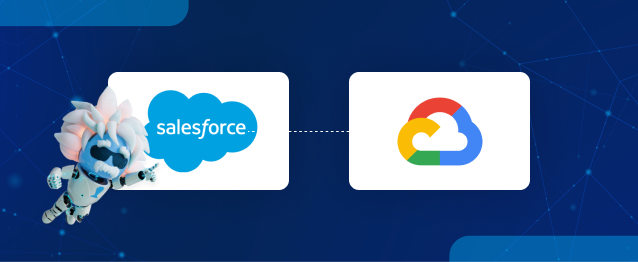
Something fundamental has shifted in enterprise automation. It’s no longer about connecting tools; it’s about enabling systems to think, decide, and act across platforms. The collaboration between Salesforce and Google Cloud is driving this shift through AI agents that operate with deep context and execute end-to-end workflows.
This blog breaks down how Salesforce Google Cloud AI Agents are transforming automation, what technologies power them, and how businesses can leverage them to build intelligent, cross-platform workflows at scale.
What Are Salesforce Google Cloud AI Agents?
AI agents are not just automation scripts or chatbots. They are context-aware systems that can:
- Understand business data
- Make decisions using AI models
- Execute actions across multiple platforms
When you combine Salesforce’s ecosystem (CRM, workflows, customer data) with Google Cloud’s AI infrastructure (LLMs, data processing, Vertex AI), you get a unified AI execution layer.
This is where:
- Salesforce Agentforce AI acts as the decision-making and orchestration layer
- Google Cloud AI automation provides intelligence via models and data pipelines
Together, they enable enterprise AI workflow automation that goes beyond triggers into autonomous execution.
Why This Integration Matters for Modern Businesses
Most companies today use multiple platforms – CRM, communication tools, and analytics systems, but they operate in silos. Traditional integrations only move data. They don’t interpret or act on it.
This is where Salesforce Google Cloud integration changes the game.
With AI agents:
- Data is not just transferred; it’s understood in context.
- Workflows are not static; they’re adaptive and intelligent.
- Decisions are not manual; they’re AI-driven and real-time.
For example:
- A sales lead in Salesforce can trigger an AI agent
- The agent analyzes intent using Google AI
- It drafts outreach, schedules follow-ups, and updates records automatically
This is cross-platform AI workflows in action.
How AI Agents Work Across Salesforce and Google Cloud
To understand the real power, let’s break down the architecture in a simplified flow.
1. Data Layer (Context Creation)
- Salesforce CRM stores structured customer data
- Google Cloud processes large-scale datasets and signals
This creates deep context, not just raw data.
2. Intelligence Layer (AI Models)
- Google Cloud’s generative AI models interpret inputs
- AI understands intent, sentiment, and next-best actions
This answers queries like:
- “what are AI agents in Salesforce”
- “how headless automation works across platforms”
3. Orchestration Layer (Agentforce)
Salesforce’s Agentforce AI Agent decides:
- What action to take
- When to take it
- Which system to use
This is where Salesforce Agentforce becomes critical.
4. Execution Layer (Cross-Platform Actions)
Actions are executed across:
- Salesforce CRM
- Google Workspace tools
- Communication platforms like Slack
This creates end-to-end workflow automation, not just isolated actions.
Key Capabilities of Salesforce Google Cloud AI Agents
This integration unlocks capabilities that traditional automation simply cannot achieve.
1. Context-Aware Decision Making
AI agents don’t rely on fixed rules. They use real-time context, combining CRM data + external signals.
2. Autonomous Workflow Execution
From lead qualification to customer support, agents can execute multi-step workflows without human intervention.
3. Multi-Platform Integration
Agents operate seamlessly across:
- Salesforce
- Google Cloud
- Slack
- Google Workspace
4. Real-Time Data Synchronization
No lag, no batch processing. Decisions happen in real time, improving speed and accuracy.
5. Scalable Enterprise Automation
From startups to large enterprises, this model supports enterprise AI workflow automation at scale.
Real-World Use Cases: Where This Actually Works
Let’s connect the technology to practical business scenarios.
Sales Automation (Agentforce Sales)
- AI agents qualify leads automatically
- Generate personalized outreach
- Update CRM and schedule meetings
This is where Agentforce Sales delivers measurable ROI.
Customer Support Automation
- AI agents analyze support queries
- Suggest responses or resolve tickets
- Escalate only when needed
Marketing Automation
- Campaigns adapt based on user behavior
- AI agents personalize messaging in real time
- Insights are fed back into Salesforce
Internal Collaboration (Slack + Google Workspace)
- Notifications triggered in Slack
- Documents updated in Google Workspace
- Tasks assigned automatically
This connects Slack and Google Workspace into the workflow loop.
Salesforce Agentforce + Google Cloud: The Competitive Edge
Most competitors talk about:
- “AI automation”
- “cloud integration”
But they miss the core shift:
From automation → intelligent agents → autonomous execution
What makes this ecosystem powerful:
- Agentforce AI Agent = orchestration + execution
- Google Cloud generative AI = intelligence + scale
- Unified data context = better decisions
This creates a closed-loop system:
Data → Intelligence → Decision → Action → Feedback → Optimization
How to Get Started with AI Agent Integration
If you’re planning to implement this, here’s a simplified roadmap:
Step 1: Define Use Cases
Start with:
- Sales automation
- Customer support
- Marketing workflows
Step 2: Structure Your Data
AI is only as good as your data. Ensure:
- Clean CRM records
- Defined workflows
Step 3: Integrate Platforms
Set up Salesforce Google Cloud integration:
- APIs
- Data sync
- Event triggers
Step 4: Deploy AI Agents
Use:
- Salesforce Agentforce
- Google Cloud AI models
Step 5: Monitor & Optimize
Track:
- Performance
- Accuracy
- ROI
Pro Tip: Working with an experienced Salesforce Partner can significantly accelerate implementation and reduce risks.
We’re moving toward a world where:
- Systems don’t just support decisions; they make them
- Workflows don’t just run; they adapt dynamically
- Platforms don’t just integrate; they collaborate intelligently
Expect:
- More autonomous AI agents
- Deeper multi-cloud integrations
- Stronger context-aware intelligence
This is not just a trend; it’s the next layer of digital transformation.
Final Thoughts
The combination of Salesforce and Google Cloud is redefining how businesses approach automation.
It’s no longer about connecting tools; it’s about creating AI agents that understand, decide, and act.
And the companies that adopt this early won’t just automate faster; they’ll operate smarter.
Frequently Asked Questions
They are intelligent systems that combine Salesforce CRM data with Google Cloud AI to automate and execute workflows across platforms with real-time decision-making.
Through APIs and data pipelines, Salesforce connects with Google Cloud’s AI models, enabling AI agents to analyze data and trigger actions across systems.
They improve efficiency, automate workflows, enable real-time decisions, and reduce manual effort in sales, marketing, and support processes.
Yes, AI agents can execute workflows across platforms like Slack and Google Workspace, enabling seamless collaboration and automation.
They replace rule-based automation with context-aware decision-making, enabling dynamic, scalable, and intelligent workflow execution.
 India
India  USA
USA UK
UK Canada