
Salesforce's Agent Fabric update, announced on October 27, 2026, enhances AI agent management by integrating evaluation tools with automated responses to performance issues. Key features include Agent Evals for pre-deployment testing and ongoing performance assessment, API Evals for identifying integration issues early, and new financial controls to manage AI usage costs. The update aims to help businesses maintain agent reliability and budget compliance while scaling their AI operations. Availability of features varies, with some in beta and others generally available.
AI agents can be useful until something goes wrong. A model change can affect the answers an agent gives, an API update can interrupt a task, or growing usage can push costs beyond expectations. The bigger concern is that these problems may continue before anyone notices.
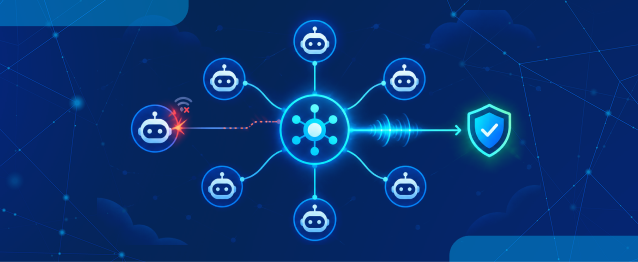
Salesforce’s latest Agent Fabric update, announced on October 27, 2026, focuses on closing that gap. Instead of relying only on teams to spot issues and respond, the platform is adding ways to evaluate agent performance, identify API problems, and trigger predefined actions.
In this blog, we will cover the key changes to Salesforce Agent Fabric, including the new evaluation tools, spending controls, and broader governance options for businesses running AI agents across different platforms.
From Spotting Problems to Stopping Them
The main change is how Salesforce connects evaluation with action. Teams can define performance expectations and decide what should happen when an agent fails to meet them. That could mean alerting the owner or restricting the agent, depending on the organisation’s policies.
Agent Evals: Catching Failures Earlier
Salesforce Agent Evals is designed to test agents before deployment and assess their performance in production. When results fall below defined quality thresholds, it can initiate a predefined response, with human approval where required.
This matters when an agent’s behaviour changes after a model update or begins returning incorrect information. Rather than waiting for customer complaints, teams have a way to identify the issue and act on it.
Poonam Deshpande, Director of Engineering, Digital Commerce at ASICS Digital, highlighted this difference:
“It doesn’t stop at telling us something is wrong.”
The value is in connecting evaluation results to an appropriate response, rather than leaving teams to manage the entire process manually.
API Evals: Checking the Connections
An AI agent can only work reliably when the systems it depends on are working as expected. API Evals is designed to generate functional and performance tests from API specifications, helping teams identify breaking changes before they affect production.
For businesses managing Salesforce API integration across several systems, this adds another checkpoint. An API change that affects how an agent retrieves customer information or completes a task can be identified earlier, before the problem spreads into a wider workflow.
Keeping AI Costs Within Bounds
Evaluation is only part of the update. Salesforce is also bringing together the FinOps Dashboard, Model Wallet, and Cost Optimization Policies to give budget owners more visibility into AI usage.
The controls include hard spending limits that can stop requests before costs exceed the configured budget. Salesforce also reports up to 75% lower token usage from its optimization policies in test scenarios, using semantic caching, payload compression, and response trimming. Results will vary by workload.
Andrew Comstock, SVP & GM of MuleSoft & Agent Fabric at Salesforce, summed up the challenge:
“Enterprises can only scale agents as fast as they can keep them accurate and on budget.”
For businesses deploying a Salesforce AI agent, the point is not simply to reduce usage. It is to manage spending while keeping the agent useful and reliable.
Extending Governance Beyond Salesforce
Salesforce is also expanding how Agent Fabric discovers assets and applies policies across different environments.
The Custom Agent Scanner lets organisations build scanners for internal systems, environments behind firewalls, and third-party platforms. Meanwhile, Open Policies for Federated API Gateways extends policy management across supported gateways from Azure, Apigee, and Kong.
These updates address a practical issue for enterprises: their AI systems rarely sit in one place. A shared view of agents, models, MCP servers, and APIs can make it easier to understand what is running and apply consistent controls.
What Businesses Should Know About Availability
The release timeline is important because not every capability is generally available yet.
- Agent Evals and API Evals: Beta planned for November 2026, with general availability targeted for January 2027.
- Custom Agent Scanner: Beta available, with general availability planned for January 2027.
- Agent Kill Switch, cost controls, and federated API gateway policies: Generally available as announced on October 27, 2026.
- Triggered-Agent Kill Switch: General availability planned for January 2027.
Businesses should confirm the latest availability and applicable licensing with Salesforce before planning implementation.
Conclusion
The latest Salesforce Agent Fabric update is about reducing the gap between identifying an AI problem and responding to it. Evaluation, spending limits, and broader governance controls give teams more ways to manage risks as their use of AI grows.
For organisations running agents across several platforms, the next step is to decide which performance checks, budget limits, and intervention rules fit their workflows. Those decisions will help determine how effectively they can scale AI without losing control over quality or cost.
Frequently Asked Questions
Salesforce Agent Fabric connects agent evaluation with predefined actions, helping businesses identify performance issues, respond to failures, and enforce controls before problems escalate.
Salesforce Agent Evals tests AI agents before deployment and monitors production performance. When results fall below defined quality thresholds, teams can trigger predefined responses, with human approval where required.
API Evals generates functional and performance tests from API specifications, helping teams detect breaking changes before they disrupt connected systems, data retrieval, or automated agent workflows.
Yes, the Custom Agent Scanner supports discovery across internal systems, environments behind firewalls, and third-party platforms, while federated API gateway policies extend governance across supported gateways.
According to the announcement covered in this blog, Agent Evals and API Evals were planned for beta in November 2026, with general availability targeted for January 2027. Timelines may change.

 India
 USA
 UK
 Canada