
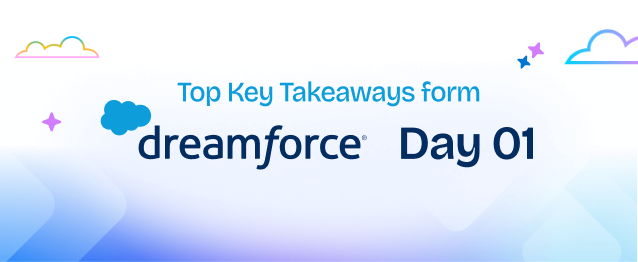
Dreamforce 2026 Day 1 made one thing clear: Salesforce is moving beyond AI assistance toward a more agentic enterprise where data, applications, business logic, and AI can work together in a much more connected way.
The main keynote introduced AIforce as a new interface layer that brings Salesforce intelligence into the places people already work. Instead of constantly switching between applications, users can interact with CRM data and workflows through AI-driven interfaces.
Along with AIforce, Day 1 also brought major updates around Claudeforce, Koa, Agentforce, trust, and Salesforce’s expanding AI ecosystem. The keynote also highlighted major partnerships with Anthropic, Google Cloud, and AWS, showing how Salesforce is building a broader AI environment.
In this blog, we will explore the crucial key notes that have been covered during Dreamforce day 1 with all the crucial things
Key Takeaways From Dreamforce 2026 Day 1
The key takeaways from Day 1 go beyond individual product announcements. Together, they show how Salesforce is thinking about the next phase of enterprise software, where AI can sit closer to the work people are already doing.
Here are the major key takeaways from the opening day.
AIforce Is Changing How People Interact With Salesforce
One of the biggest announcements at DF26 was AIforce, which Salesforce positioned around a simple idea, AI can become the new way people interact with enterprise software. Users can access CRM context through Claude, Slack, Lightning, and other places they already work.
The goal is to reduce context switching. Instead of opening Salesforce for every action, users can ask questions, update records, trigger workflows, and work with business information through an AI-driven interface.
AIforce Brings Multiple Pieces Into One Experience
AIforce is not just one feature. Salesforce presented it as a package that includes Claudeforce, Slackforce, Agentforce Coworker, and a Headless Toolkit containing MCPs, APIs, plug-ins, skills, and developer tools.
This approach also changes the traditional Salesforce experience. The system of record remains Salesforce, while users can work with that information through different interfaces based on where they are working at the time.
Claudeforce Moves Into Open Beta
Claudeforce was another major part of the Day 1 discussion, and Salesforce demonstrated how Claude can work with Salesforce context through a more conversational interface. The Salesforce for Claude plugin uses MCP servers, zero data retention, and writing skills.
The features shown during the keynote were described as open beta. Salesforce also pointed attendees toward Trailhead and AI learning labs for people who want to explore the new capabilities further.
Four Layers Are Coming Together for Enterprise Intelligence
Another important part of the Salesforce Dreamforce keynote was the idea of bringing several layers of intelligence together. These include the data layer, application and semantic layer, agentic layer, and interface layer.
The agentic layer includes examples such as Hunter for sales, Piper for pipeline generation, and Marshall for operations, while the interface layer brings experiences such as Claude Co-work closer to enterprise workflows.
Together, these layers show how Dreamforce 26 is looking at AI as something that can work across data, business logic, agents, and the interface instead of sitting separately from the rest of the system.
Koa Adds CRM-Specific Reasoning to Agentforce
Salesforce also introduced Koa, a CRM reasoning model designed for complex and longer-running tasks. The model was trained using synthetic data to support reasoning within CRM-related work.
The addition of Koa is important because the focus is moving beyond simply generating an answer. The model is intended to support more complex reasoning across CRM scenarios and longer workflows.
Trust and Zero Data Retention Remain Central
Trust was another major theme throughout Day 1. Salesforce stressed that customer data remains with the customer and is not used to train external models in the way users might worry about. Zero data retention was highlighted as an important part of the approach.
Salesforce also highlighted tools and concepts such as Salesforce Guardian and Agent Fabric as part of its wider approach to enterprise AI governance and control. Thus, the push toward more AI-driven work is being presented alongside a strong focus on how business data is handled.
Salesforce Expands Its AI Partnerships
The partnership announcements were another important part of DF26 Day 1, with Salesforce showing that its AI strategy extends beyond its own products and models.
The Anthropic partnership brings Claude and Salesforce closer together through Claudeforce, including a plugin with prebuilt sales skills. Anthropic CEO Dario Amodei also discussed the pace of AI development and how Claude is being used with Salesforce data.
Salesforce also announced expanded work with Google Cloud and AWS, connecting Salesforce’s enterprise AI capabilities with major cloud infrastructure and technology ecosystems. These partnerships add another layer to the broader strategy being presented at Salesforce Dreamforce 2026.
Salesforce Brings Live CRM Experiences Into Slack
Slackforce Surfaces brings Salesforce data directly into Slack through live, interactive experiences. Users can ask Slackbot in plain language to create dashboards, reports, executive presentations, or other visual interfaces using their available work context.
What makes this interesting is that these surfaces stay connected to the source data and can refresh as information changes. Teams can also explore the data, ask follow-up questions, filter information, and collaborate directly inside Slack, without building every dashboard from scratch.
AI Infrastructure Is Becoming Part of the Conversation
Jensen Huang’s appearance also brought the discussion toward the infrastructure needed to support the rapid growth of AI. The keynote connected this shift with the idea of a new AI infrastructure layer and the engineering challenges around safety.
This added a broader technology perspective to Salesforce Dreamforce, showing that the conversation is no longer limited to CRM features. AI infrastructure, models, agents, and enterprise applications are increasingly being discussed as connected pieces.
Wrapping Up: What Will Day 2 of Dreamforce 2026 Bring?
Day 1 has already given us plenty of key takeaways, but Dreamforce 2026 is a three-day event, so there is still more to come. The next sessions should give businesses more context around how these announcements translate into real-world workflows and everyday enterprise use.
For businesses already exploring Agentforce, AI interfaces, CRM automation, or new ways to connect enterprise data, the remaining sessions will be worth watching closely. As a Salesforce partner, HIC Global Solutions will continue tracking the important announcements and updates.
Stay tuned with HIC and follow us on social media to get quick updates from Dreamforce 2026 and the latest Salesforce developments.
Frequently Asked Questions
Dreamforce 2026 Day 1 highlighted AIforce, Claudeforce, Koa, Agentforce, Slackforce, AI partnerships, and new approaches to connecting enterprise data, applications, agents, and interfaces.
AIforce brings Salesforce intelligence into interfaces where users already work, allowing them to interact with CRM data, workflows, and business processes without constantly switching between applications.
Claudeforce brings Claude closer to Salesforce workflows, using Salesforce context and MCP-based capabilities to support more conversational interactions with enterprise CRM information.
Koa is a CRM reasoning model introduced by Salesforce for complex and longer-running tasks. It is designed to support deeper reasoning across CRM-related scenarios within Agentforce.
Slackforce Surfaces brings live Salesforce data into Slack, allowing users to create and explore dashboards, reports, presentations, and other interactive experiences using natural-language requests.

 India
India  USA
USA UK
UK Canada