
Purchase Orders are used to manage inventory procurement, vendor orders, product replenishment, and supply chain operations.
Using MultiSync Made Easy, organizations can synchronize Purchase Orders between NikoHealth and Salesforce while maintaining relationships with:
- Vendors
- Products
- Purchase Order Items
- Locations
In this guide, we will configure:
- NikoHealth → Salesforce Purchase Order Synchronization
- Salesforce → NikoHealth Purchase Order Synchronization
- Purchase Order Item Synchronization
- Product Synchronization
- Legacy Purchase Order Import
- Real-Time Purchase Order Synchronization
Before configuring Purchase Order synchronization, ensure the following integrations are already completed:
Required Integrations
- NikoHealth Authorization
- Product Synchronization
- Inventory Synchronization
Since Purchase Orders contain Products and Inventory information, those objects should already be synchronized.
Related Guides:
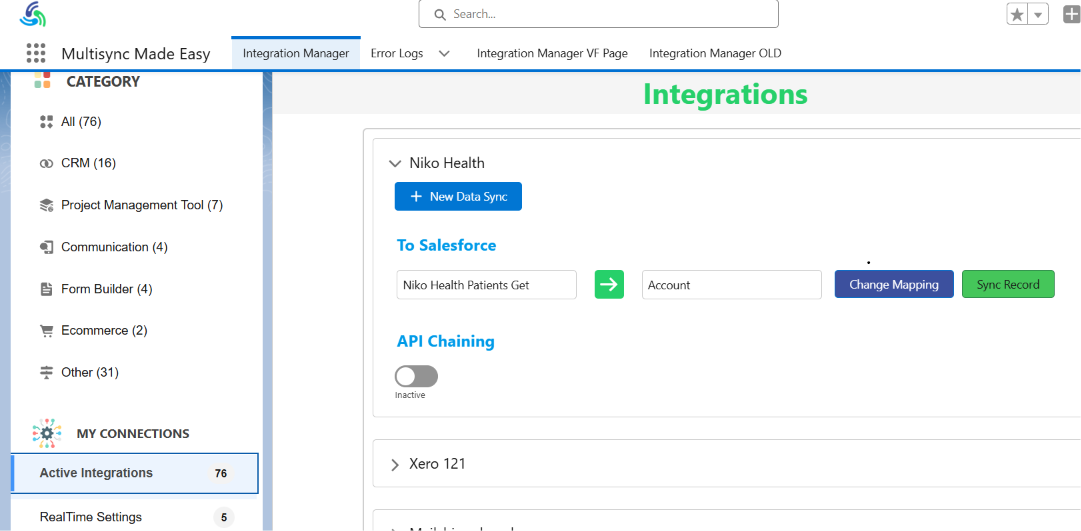
Step 1: Open MultiSync Made Easy
- Navigate to App Launcher.
- Open MultiSync Made Easy.
- Go to Active Integrations.
- Locate the NikoHealth integration.
Step 2: Create a New Purchase Order Synchronization
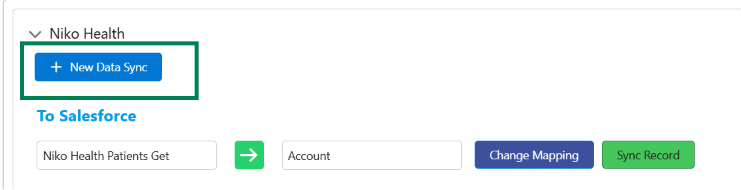
- Click + New Data Sync.
- This opens the synchronization wizard.
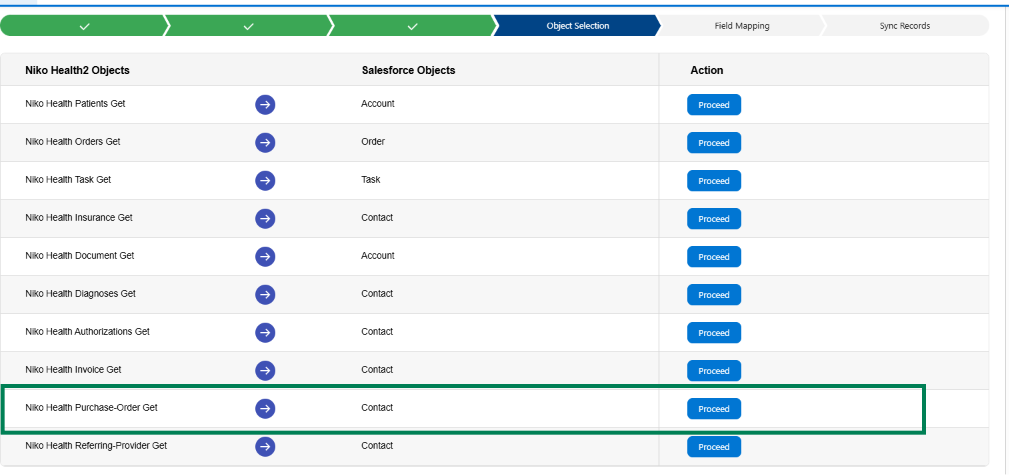
Step 3: Configure Object Mapping
- Select NikoHealth Object → NikoHealth Purchase Order Get.
- Select Salesforce Object → Contact.
- Click Proceed.
Step 4: Configure Purchase Order Field Mapping
- Map the Purchase Order fields from NikoHealth to the corresponding Salesforce fields.
Example:
| NikoHealth Field | Salesforce Field |
|---|---|
| Id | Niko_PO_Id__c |
| DisplayId | Display_Id__c |
| Vendor.Name | Vendor_Name__c |
| Vendor.Id | Vendor_Id__c |
| TotalPrice | Total_Amount__c |
| AccountNumber | Account_Number__c |
| Notes | Notes__c |
| Status.Name | Status__c |
| Location.Name | Location__c |
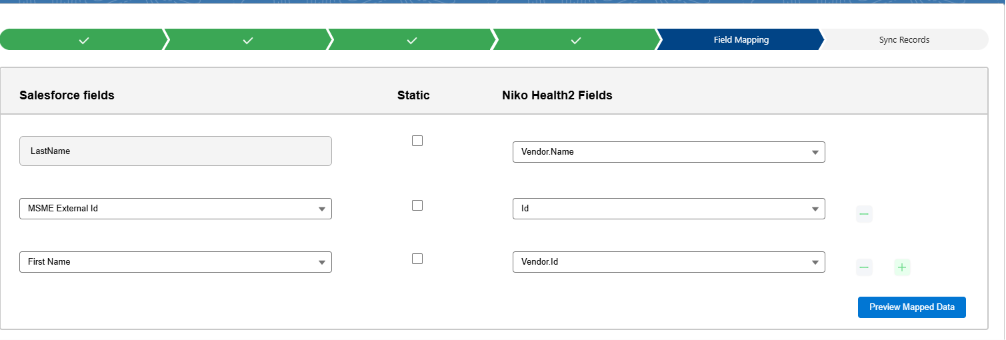
Step 5: Preview and Validate Mapping
- Click Preview Mapped Data.
Review:
- Purchase Order Information
- Vendor Information
- Product Information
- Purchase Order Items
Validate the mapped information.
Save the mapping.
Step 6: Import Existing Purchase Orders
- Navigate to Sync Records.
- Choose Sync Data to import the existing Purchase Orders.
- Or choose Schedule Data Sync to schedule the import.
- Import the Historical Purchase Orders from NikoHealth.
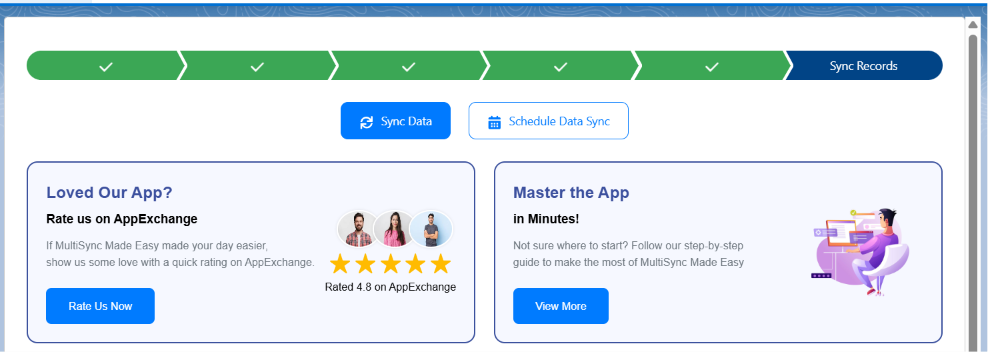
Step 7: Complete Legacy Purchase Order Synchronization
MultiSync Made Easy handles the required Purchase Order data during the synchronization process.
- Retrieve Purchase Orders from NikoHealth.
- Retrieve Purchase Order Items.
- Retrieve Product Information.
- Create Purchase Orders in Salesforce.
- Create Purchase Order Items.
- Maintain Parent-Child Relationships.
Product Relationship Mapping
Each Purchase Order Item is connected to its related Product.
- Step 1: Read the Product information.
- Step 2: Locate the Product in Salesforce.
- Step 3: Populate the Product lookup on the Purchase Order Item.
- Result: Create the Purchase Order Item → Product relationship.
Purchase Order Item Relationship Mapping
Each Purchase Order Item is attached to its parent Purchase Order.
Result:
Purchase Order
├─ Item 1
├─ Item 2
├─ Item 3
Users can view all items directly from the Purchase Order.
Step 8: Verify Purchase Order Synchronization
- Open a Purchase Order record.
Verify:
- Vendor Information
- Status
- Total Amount
- Product Items
- Item Quantities
- Pricing Information
Real-Time Purchase Order Synchronization
This step helps confirm that the NikoHealth with Salesforce setup has brought the required Purchase Order information into Salesforce correctly.
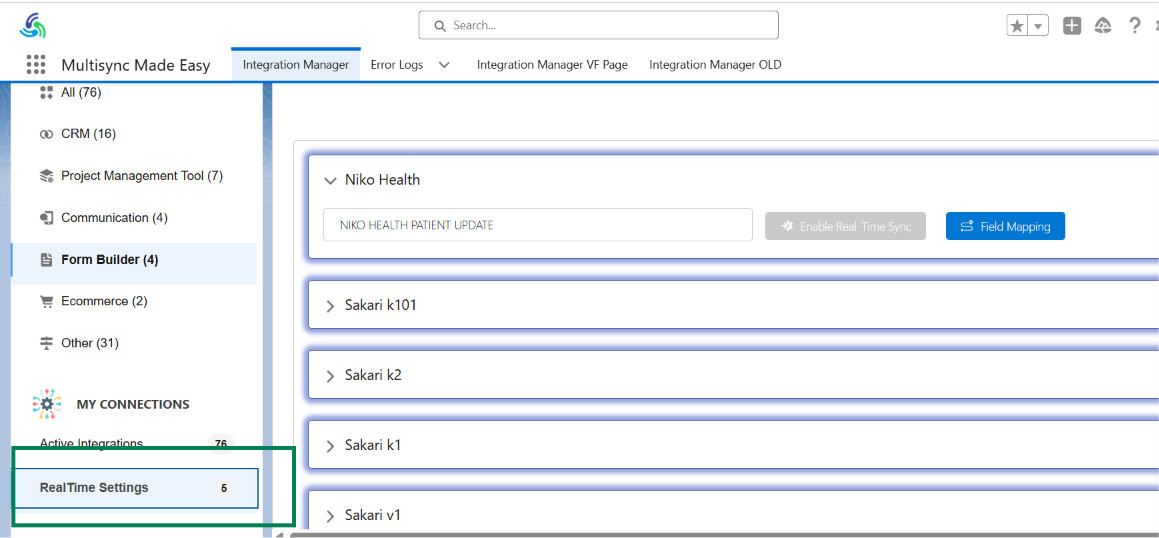
Step 9: Open Real-Time Settings
- Navigate to RealTime Settings.
- Locate NikoHealth Purchase Orders.
- Open the available real-time configuration options.
Step 10: Configure Purchase Order Events
Enable the Purchase Order events that should trigger synchronization.
- Enable Purchase Order Created.
- Enable Purchase Order Updated.
- Configure these events to trigger synchronization whenever Purchase Orders change in NikoHealth.
Step 11: Enable Real-Time Sync
- Click Enable Real-Time Sync.
- Turn on automatic synchronization for Purchase Orders.
- Confirm that the configured events are enabled.
With this Salesforce NikoHealth integration setup, new or updated Purchase Orders can be synchronized automatically instead of requiring users to run the sync manually.
Salesforce to NikoHealth Purchase Order Synchronization
The integration also supports sending Purchase Order information from Salesforce back to NikoHealth.
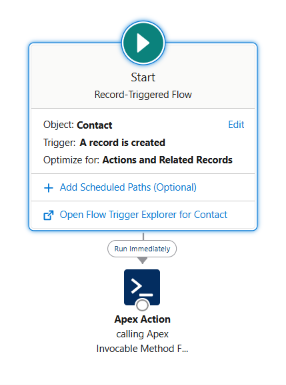
Step 12: Configure Salesforce Automation
Configure a Salesforce Flow on the Contact object.
- Set the Flow to run when a Purchase Order is Created.
- Set the Flow to run when a Purchase Order is Updated.
- Configure the Flow to invoke an Apex Action.
Step 13: Build the Purchase Order Payload
Prepare the Purchase Order payload with the required information.
Purchase Order Information
- Vendor
- Notes
- Account Number
- Location
Shipping Information
- Address
- City
- State
- Zip Code
Purchase Order Items
- Product
- Quantity
- Price
- Discount
- SKU
- Notes
This allows NikoHealth and Salesforce to exchange the Purchase Order details required for the synchronization.
Step 14: Create or Update Purchase Order in NikoHealth
Before sending the Purchase Order data, check whether a NikoHealth Purchase Order ID already exists.
- If Niko Purchase Order ID Exists → Execute PUT Purchase Order.
- If Niko Purchase Order ID Does Not Exist → Execute POST Purchase Order.
- Use the same process for both Purchase Order creation and updates.
Step 15: Store the NikoHealth Purchase Order ID
When a new Purchase Order is created, NikoHealth returns the Purchase Order ID:
{
“Id”:”PO123456″
}
Salesforce stores:
Niko_PO_Id__c
This ID is used for future updates.
Step 16: Verify Bidirectional Synchronization
Verify that Purchase Orders are synchronizing correctly in both directions.
NikoHealth → Salesforce
- Create or update a Purchase Order in NikoHealth.
- Verify that the Purchase Order is created or updated in Salesforce.
- Verify that the Vendor is linked.
- Verify that the Products are linked.
- Verify that the Purchase Order Items are created.
Salesforce → NikoHealth
- Create or update a Purchase Order in Salesforce.
- Verify that the Purchase Order is created or updated in NikoHealth.
- Confirm that the Purchase Order information is synchronized correctly.
Result
After implementing this configuration:
- Historical Purchase Orders are synchronized.
- Purchase Order Items are synchronized.
- Product relationships are maintained.
- Vendor relationships are maintained.
- Real-time synchronization is enabled.
- Salesforce can update NikoHealth.
- NikoHealth can update Salesforce.
- Duplicate Purchase Orders are prevented.
Conclusion
With MultiSync Made Easy, businesses can keep Purchase Orders, Purchase Order Items, and Product information synchronized between NikoHealth and Salesforce, making procurement data easier to access, manage, and track.
For businesses looking for reliable Salesforce services and Salesforce integration services, HIC Global Solutions, a trusted Salesforce partner, helps connect business systems and build practical solutions around Salesforce.
With the right synchronization setup, teams can reduce manual data entry, maintain accurate records, and keep important Purchase Order information updated across NikoHealth and Salesforce as business operations move forward.
Watch Demo Video
Frequently Asked Questions
Businesses can improve NikoHealth and Salesforce data accuracy by standardizing field mappings, validating relationships, and monitoring synchronization results, while Move to Slack supports broader workflow collaboration across teams.
Yes, NikoHealth and Salesforce integration can support growing organizations by automating data movement, reducing repetitive entry, and maintaining connected records, while Move to Slack complements scalable collaboration workflows.
Salesforce integration with NikoHealth reduces manual data entry by automatically transferring relevant information between systems, minimizing duplicate work and errors, while Move to Slack can streamline team communication.
Salesforce integration services can customize NikoHealth workflows around business requirements, including automation, data mapping, and synchronization logic, while Move to Slack helps teams coordinate integration-related operational activities.
NikoHealth integration suits Salesforce-focused companies needing connected operational data, automated workflows, and centralized visibility, while Move to Slack can complement these processes through organized communication and collaboration.

 India
India  USA
USA UK
UK Canada