Loading...
New Winner – Cross-Border Excellence | Payoneer India 2026 Check out
Featured Recognized by Salesforce; Proven by impact! Check out

Integrating HubSpot with Snowflake in a bi-directional sync enables seamless data flow between the CRM and data warehouse. This setup allows for real-time updates of customer insights, driving better decision-making and personalized marketing.

By syncing data both ways, organizations can enhance CRM functions in HubSpot and leverage Snowflake’s analytics power, ensuring a unified view of business data.

In this blog, let’s explore how to integrate Snowflake with HubSpot in a bi-directional sync.

Prerequisite

  • You must have a Snowflake account
  • HubSpot Developer account
  • Basic Knowledge of SQL
  • Basic Knowledge of node.js, and REST APIs

Let’s check out the step-by-step guide.

Step 1: Create HubSpot Private App

  • HubSpot->Settings->Integrations->Legacy App->Create Legacy App->Private App
Screenshot 61 3
  • Enter the name of the app.
Screenshot 58 3
Screenshot 59 5
  • Go to the ‘Scopes’ option, then select the scopes.
Screenshot 60 3
  • In Webhooks, enter the target URL and click on ‘Create subscription’.
Screenshot 85
  • Click on Create App
  • Copy the Private App Access Token

Step 2: Create a table in Snowflake

  • Sign in to the Snowflake account.
  • In the side panel, click on the + icon
Screenshot 86
Screenshot 87
  • Choose the Database and schema 
  • Write the SQL query for creating the table
Screenshot 88
  • Click on the create table button.

Step 3: Create a Node.js project

  • Inside the project folder, run these commands in your command prompt: npm init -y and npm install express axios, snowflake-sdk dotenv body-parser
  • hubspot-to-snowflake.js (For Hubspot to Snowflake connection)
Screenshot 89
Screenshot 90 1
Screenshot 91
Screenshot 92
Screenshot 93
Screenshot 94
Screenshot 95
Screenshot 96
Screenshot 97
Screenshot 98
Screenshot 99
Screenshot 100
  • .env
Screenshot 101

Step 4: Run the project

  • Run node file-name and npx ngrok http 3000 (if running on a local machine/laptop)
Screenshot 102
Screenshot 106
Screenshot 103
Screenshot 104
Screenshot 105

Live Demo

Conclusion

Integrating Snowflake with HubSpot in a bi-directional sync ensures real-time data consistency, improving marketing and sales alignment. It enables deeper customer insights and automates data-driven decisions, driving efficiency and scalability across teams.

For organizations using Salesforce alongside HubSpot, this architecture also complements Salesforce integrations and Salesforce AI initiatives by centralizing analytics in Snowflake.

With the right HubSpot Development Services, businesses can extend this setup to unify CRM data, power AI-driven forecasting, and create a truly connected data ecosystem.

No Data Found.

Related Articles
How to Connect Salesforce with Claude AI Using an MCP Server

Claude AI can make working with Salesforce CRM data much easier. Instead of manually opening records, building reports, or writing SOQL queries, teams can ask Claude questions in plain English and get answers from their Salesforce org. With Salesforce MCP, users can explore CRM information through a conversational interface, helping them find relevant details with […]

Read More
How to Set Up Salesforce Claudeforce Using the Headless 360 MCP Server

Setting up Salesforce Claudeforce requires more than simply connecting Salesforce with Claude. The process involves beta access, the Salesforce Headless 360 MCP Server, an External Client App, plugin configuration, and user-level permissions. Each part of the setup is important because Claude needs controlled access to Salesforce data and actions while still following the user’s existing […]

Read More
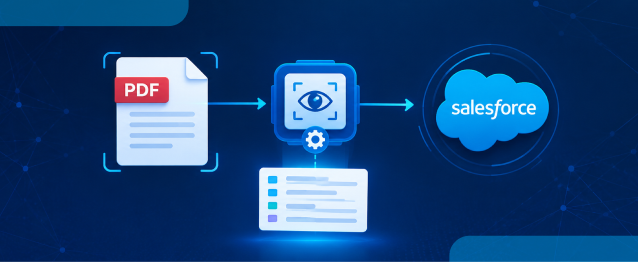
How to Extract Data from PDFs Using OCR.space API in Salesforce

Many times it’s crucial to extract information from documents such as loan statements, invoices, applications, identity documents, and scanned forms. When the information is stored as an image or scanned PDF, it cannot be directly read and used as regular text. This is where Salesforce OCR becomes useful. Optical Character Recognition can convert text from […]

Read More
Passwordless Login with Passkeys in Salesforce: A Practical Setup Guide

Passwordless login with passkeys gives Salesforce users another way to authenticate without entering a traditional password every time. Instead, users can verify their identity through a device, browser, or supported passkey manager. For Salesforce admins and consultants, setting up passkeys requires a little planning. Each user needs access to their own registered passkey, and backup […]

Read More
How to Configure Salesforce for Google Chat Integration

Google Chat integration with Salesforce connects team communication with Salesforce data, helping teams receive important updates without constantly switching between platforms. It makes collaboration simpler and keeps sales teams informed. The integration works across three key components: Salesforce: Acts as the source system for business information, record updates, and automation. Google Cloud Console: Provides the […]

Read More
How to Integrate Tasks Between NikoHealth and Salesforce

How to Integrate Tasks Between NikoHealth and Salesforce Tasks play an important role in healthcare workflows and can be associated with Patients, Orders, Invoices, Documents, and Assigned Staff Members. With MultiSync Made Easy, organizations can synchronize Task records while maintaining these important relationships. This Niko Health image-based workflow also makes it easier to understand how […]

Read More
Our Location worldwide
Indian Flag India
3rd Floor, A-10, Pegasus Tower, Sector 68, Noida, Uttar Pradesh 201301 +91-1203669505
United States of America Flag USA
333 West Brown Deer Road Unit G – 366 Milwaukee WI, USA 53217 +1(262) 310-7818
United Kingdom Flag UK
7 Bell Yard, London, WC2A 2JR +44 20 3239 9428
CA Flag Canada
HIC Global Solutions INC
6D - 7398 Yonge St #1124 Thornhill, ON L4J 8J2 Canada +1(262) 310-7818