
Loading...

Beginning February 01, 2022, all Salesforce users must use Multi-Factor Authentication (MFA) if they want to access Salesforce products. MFA acts as an extra layer of security that protects your data from threats like phishing attacks. Thus, helping you in keeping your business’ and customers’ sensitive data safe.

If you’re willing to know more about MFA in Salesforce, you can read my article published on Salesforce Ben.

1 112079db70

When Are Users Prompted for Multi-Factor Authentication?

When you enable MFA, you’ll be required to provide multiple factors every time you log in. You can set up this requirement for user interface logins, API logins, or both.


To step up security, even more, you can add an MFA requirement for additional circumstances:

  1. When users access a connected app, dashboard, or report. This process is known as step-up or high-assurance authentication.

  2. During a custom login flow or within a custom app.

Steps for Implementing MFA Using Salesforce Authenticator App

Prerequisites

  1. Salesforce Trailhead playground or Developer Edition account
  2. Salesforce Authenticator application (supported on both Android & IOS)

Step 1: Login into your Salesforce account

Step 2: On the setup page, search “Permission Set.”

Step 3: Click the “New” button to create a new permission set for the user and enter the label name. The API name will automatically generate, then click the “Save” button.

s3 11208a8fe5

Step 4: After saving, scroll down and click “System Permissions” under the system section in the created permission set. Then click the “Edit” button.

s4 112093625e

Step 5: Scroll down or search “Multi-Factor Authentication for User Interface Logins” and enable the check box. To save the update, click the “Save” button.

s5 1121010226

Step 6: Click the “Manage Assignments” button and then click the “Add Assignments” button to add users.

Step 7: Select the user to enable two-factor authentication, then click the “Assign” button.

Step 8: Click the “Done” button and activate the created permission set.

Step 9: Log out of your Salesforce account.

Step 10: Download and install the “Salesforce Authenticator” application from your mobile device’s app.

s10

Step 11: Open the “Salesforce Authenticator” app and click “Add an Account.”

s11

Step 12: On your mobile device, the app displays a two-word phrase authenticator. Hold that word on your mobile device.

s12

Step 13: Log in to the Salesforce account that created the permission set.

13 112144bcee

Step 14: After clicking on the login button, the “Connect Salesforce Authenticator” page will be opened. Enter the two-word phrase from the Salesforce Authenticator application and then click the “Connect” button.

s14
  • And also salesforce provide other verification methods
mfa

Step 15: Now, check your Salesforce Authenticator app; it will prompt you to connect with the authenticator. Click on the “Connect” button.

15 112178e3ed

Step 16: Your mobile device now displays your username and service name. Check the details after clicking the “Connect” button on your mobile device.

16 11218e3834

Step 17: If successfully connected, you’ll be automatically redirected to your Salesforce account’s main page. You can log out of this session to test your multi-factor authentication.

Step 18: Again, enter your login credentials and then click the “Login” button. If Salesforce Authenticator app, approve this salesforce org using “Approve” button. It will automatically redirect to the salesforce main page.

Conclusion

So, now, you know how to implement MFA in Salesforce. You need to know this implementation as February 1, 2022, is just around the corner. If you need further help or assistance, contact us so that our experts can help you. If you try out our solution, then do share your experiences with us. Till then, happy learning! 🙂

No Data Found.

Related Articles
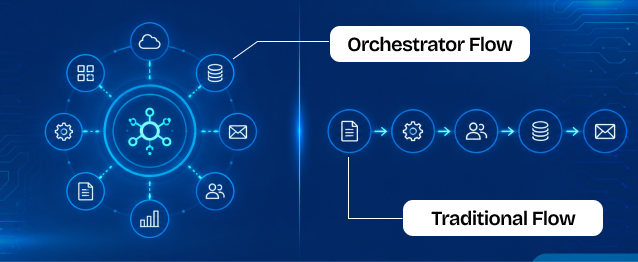
Orchestrator vs. Traditional Flows

Businesses use Salesforce automation to reduce manual work, improve efficiency, and automate repetitive business processes. Two commonly used automation approaches inside Salesforce are Traditional Flows and Flow Orchestrator. Traditional Flows are mainly used for simple automation tasks such as updating records, sending notifications, creating tasks, and automating business logic. Flow Orchestrator is designed for more […]

Read More

The Rise of Agentic Government_ What Salesforce’s 2026 Insights Mean for the Future of Public Sector AI

Government technology has often been seen as slower to evolve than the private sector. But Salesforce’s latest research challenges that idea in a big way. In fact, the new findings suggest that public sector organizations may now be moving faster than many businesses when it comes to adopting AI agents and preparing for a more […]

Read More

How To Use Email Service in APEX

Managing approvals, updates, and record changes directly from email can significantly improve efficiency within Salesforce workflows. Instead of logging in, navigating records, and manually updating fields, users can simply respond to emails and trigger automated updates using Email Service in APEX. This approach is especially useful for businesses leveraging Salesforce automation and looking to enhance […]

Read More

Design and Implementation of Salesforce Jira Task Integration 1 1

Businesses have been using Salesforce for CRM operations and Jira for Agile project tracking. However, without integration, teams manually update both systems, leading to data inconsistency and inefficiency.This mechanism establishes a real-time integration between Salesforce and Jira, allowing seamless synchronization of tasks and agile board statuses.  A custom Salesforce dashboard was developed that replicates Jira-style […]

Read More

Dark Mode in Salesforce Enabling It and Creating Theme Ready Lightning Web Components with SLDS 2.0 1 1

With the Winter ’26 release, Salesforce introduced Dark Mode in Lightning Experience. Dark Mode has been introduced as a beta feature in Winter ’26, and at first it was available only for Starter Edition orgs. It is now rolling out further with Spring ’26 to Professional, Enterprise, and Developer editions. To use Dark Mode, Salesforce […]

Read More
How to Merge and Brand PDF Files in Salesforce Using LWC Visualforce PDF LIB 1

Salesforce developers frequently encounter document automation requirements that go beyond standard Apex-based PDF generation. From merging multiple ContentVersion files to dynamically applying branding like watermarks and headers, traditional server-side approaches often hit Salesforce heap size limits (6MB/12MB), creating performance and scalability challenges. This guide presents a heap-limit-safe PDF merging architecture in Salesforce using Lightning Web […]

Read More
Our Location worldwide
Indian Flag India
3rd Floor, A-10, Pegasus Tower, Sector 68, Noida, Uttar Pradesh 201301 +91-1203239658
United States of America Flag USA
333 West Brown Deer Road Unit G – 366 Milwaukee WI, USA 53217 +1(262) 310-7818
United Kingdom Flag UK
7 Bell Yard, London, WC2A 2JR +44 20 3239 9428
Canada Canada
HIC Global Solutions INC
6D - 7398 Yonge St #1124 Thornhill, ON L4J 8J2 Canada +1(262) 310-7818