
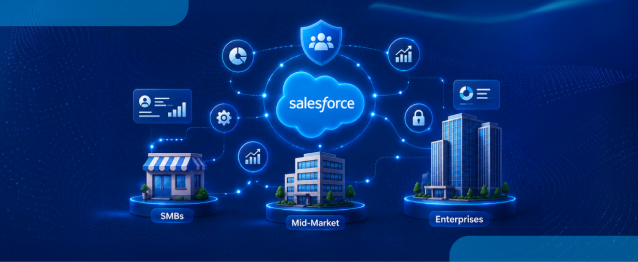
Running a modern business requires a robust Salesforce CRM platform that connects teams, organizes customer data, and delivers real-time operational insights. In today’s competitive environment, waiting for information across disconnected systems is no longer practical, especially when modern buyers expect immediate responses across every channel.
For years, the software was primarily associated with large corporate deployments because of its deep customization capabilities. However, with continuous advancements in artificial intelligence and real-time data harmonization, these capabilities are now accessible to organizations at every stage of growth.
The numbers reflect this major shift toward smarter digital operations. According to Salesforce’s Q1 FY27 results, Agentforce and Data 360 generated nearly $3.4 billion in annual recurring revenue (ARR), showing the growing adoption of Salesforce’s AI-powered solutions.
From startups to enterprises, discover why Salesforce CRM continues to stand out.
Why Salesforce Is Becoming a Preferred Choice for SMBs and Startups
Small businesses often operate with lean teams where individual employees manage sales, service, and administration at the same time. When customer details are scattered across spreadsheets and private inbox threads, operational challenges can quickly slow down revenue growth.
Adopting solutions like Salesforce for small businesses allows lean teams to automate repetitive administrative tasks and maintain organized records. Additionally, choosing Salesforce for small companies gives startups a strong foundation so they do not outgrow their core technology as customer acquisition increases.
Moreover, deploying a centralized Salesforce CRM provides growing organizations with a single source of truth across all customer touchpoints, helping teams access accurate information whenever required.
Managing Customer Data From the Beginning
When startups begin, basic spreadsheet tracking often works well for managing customer information. However, as the business grows, static files quickly become difficult to maintain and limit visibility into important customer activities.
Implementing Salesforce for small companies creates clear channels and brings lead histories into a unified dashboard. This helps businesses organize customer information, track interactions, and understand their sales journey more effectively.
Recent data published in Salesforce’s Small & Medium Business Trends Research shows that 91% of SMBs using AI say it boosts their revenue, while 85% see a direct return on their technology investment. Furthermore, growing companies that adopt dedicated CRM tools report a 29% boost in sales productivity and a 27% increase in deal win rates.
Making Sales Processes More Organized
Manual administrative work can take away hours of valuable selling time every week. Sales representatives often spend their time updating pipeline stages, creating routine outreach messages, and managing follow-up tasks manually.
Implementing Salesforce for SMBs workflows helps organize sales pipelines by automating repetitive background activities. With Salesforce for small companies, automated follow-ups ensure prospects are never forgotten, while tailored Salesforce for SMBs setups help sales representatives focus on high-intent accounts automatically.
Additionally, these organized workflows allow sales teams to spend more time building customer relationships instead of handling repetitive tasks.
Bringing AI Support With Agentforce
Artificial intelligence has grown beyond basic content generation and has become a practical solution for supporting business workflows. Today, businesses can use intelligent tools that understand company information, assist employees, and complete multiple tasks with less manual effort.
Through Agentforce, autonomous digital agents execute multi-step actions using secure company context, helping businesses improve productivity and customer engagement.
Highlighting this change in the Agentforce GA Announcement, Marc Benioff, Chair and CEO of Salesforce, stated:
“Agentforce is redefining what’s possible in business and beyond, ushering in a new era of AI abundance and limitless workforces that augment every employee, build deeper customer relationships and drive unprecedented growth and profitability.”
- Enterprise deployments report up to a 40% reduction in routine IT tickets and human touchpoints.
- Selecting Salesforce for small companies allows entrepreneurs to delegate routine data entry tasks to digital agents while focusing on strategic growth.
- According to Salesforce, Agentforce has helped transform customer support by handling hundreds of thousands of customer conversations and resolving more than 84% of customer questions through AI-powered assistance.
Understanding Customers Better With Data Cloud
Customer interactions happen across websites, email channels, support portals, and mobile apps. The biggest challenge for growing teams is connecting these separate touchpoints into one complete customer profile.
The adoption of Salesforce for SMBs tools connects data gaps without requiring complex developer builds. Data Cloud combines information from multiple channels, allowing small teams to deliver personalized customer experiences similar to larger competitors.
In addition, businesses can use these connected insights to better understand customer needs, improve engagement, and create stronger relationships.
Keeping Teams Connected With Slack
Fast-growing companies depend on quick collaboration to keep active deals moving forward. When customer updates are hidden inside private chat conversations or long email chains, important sales opportunities can easily get delayed.
With connected collaboration tools, teams can keep conversations linked with CRM information and respond faster.
- Connects team chat channels directly to live CRM account records.
- Allows representatives to update deal stages without leaving the Slack workspace.
- Alerts cross-functional team members immediately when a high-value account requires attention.
Why Salesforce Continues to Be Important for Enterprises
Large organizations operate at a massive scale, managing multiple business units, strict compliance requirements, and millions of customer transactions. For global companies, Salesforce for enterprises provides the flexibility and scalability needed to keep different departments aligned while maintaining secure operations.
According to a Forrester Total Economic Impact™ study, organizations using Salesforce Marketing Cloud achieved nearly 300% ROI over three years, driven by improved efficiency, increased revenue, and cost savings. Large organizations continue to rely on Salesforce CRM to connect different business units through one secure and reliable platform.
Managing Large Sales Operations With Sales Cloud
Enterprise sales operations involve complex account structures, thousands of products, and multiple approval processes. Managing these activities without a unified platform can create visibility issues, affect decision-making, and result in revenue challenges.
Using Salesforce for enterprises through Sales Cloud helps organizations bring regional sales pipelines together into executive dashboards. According to a Salesforce Newsroom Virtual Selling Report, intelligent workflow automation and agentic tools cut sales quoting turnaround times by up to 75%.
Creating Better Customer Experiences With Service Cloud
Enterprise customer expectations continue to increase, with users expecting support through multiple channels, including phone, chat, and self-service portals. When support systems are disconnected, businesses often experience longer resolution times and customer dissatisfaction.
Recent data from Salesforce Research highlights key service metrics:
- 79% of service leaders confirm that investing in AI agents is necessary to remain competitive.
- 88% of service professionals state that conversational AI accelerates overall resolution times.
- Deploying AI service tools reduces average customer case resolution times by up to 32%.
Connecting Enterprise Data Through Data Cloud
Large organizations often deal with complex data environments where important information is stored across different ERPs, legacy systems, databases, and billing platforms. The main challenge is not the availability of data, but accessing and using it effectively in real time.
With Salesforce for enterprises, Data Cloud helps connect these disconnected data sources into a real-time data foundation. This allows enterprise teams to provide accurate and trusted information to analytics systems and intelligent tools without requiring expensive data migration projects.
Using Agentforce for Smarter Enterprise Workflows
At the enterprise level, Agentforce helps organizations manage large-scale workflows by handling complex operational activities. Instead of depending completely on manual processes for routine approvals and tasks, intelligent digital assistants can support employees and improve efficiency.
Highlighting this evolution in the Agentforce 360 Release, Marc Benioff stated:
“We’re entering the age of the Agentic Enterprise — where AI elevates human potential like never before. Agentforce 360 connects humans, agents, and data on one trusted platform, helping every employee and every company achieve more than they ever thought possible.”
Turning Complex Data Into Simple Insights With Tableau
Enterprises generate huge amounts of operational data every day, but raw numbers alone cannot support effective business decisions. Transforming complex information into clear and meaningful insights requires powerful visualization solutions.
Tableau converts large datasets into easy-to-understand executive dashboards. Business leaders can identify market trends, analyze regional performance, and improve strategies using unified insights.
Scaling Operations With Automation
As organizations expand, manual processes and repeated handoffs can create delays and increase the chances of errors. Salesforce CRM automation helps global companies standardize operations across different departments and regions.
- Coordinates complex deal approvals across finance, legal, and executive teams.
- Ensures consistent service delivery and compliance auditing across global regions.
- Adapts dynamically as business models and international regulatory requirements change over time.
Salesforce for SMB Growth Kit: Helping Small Businesses Adopt Connected Technology
In exciting news for growing businesses, Salesforce recently announced the Salesforce for SMB Growth Kit, a unified package designed to help smaller companies adopt enterprise-level technology faster. This customized bundle combines Agentforce Sales, Slack, and Tableau into an accessible solution.
Using Salesforce for small businesses growth kit bundle makes technology adoption simpler and more cost-effective. Deploying Salesforce for SMBs solutions helps growing teams achieve faster results while reducing administrative workload.
- Agentforce Sales: Provides AI-powered support that helps sales representatives organize priorities, identify deal risks, and create context-based communications.
- Embedded Collaboration: Connects team communication directly with CRM records through built-in Slack workflows.
- Turnkey Analytics: Provides immediate visibility into sales pipelines and performance metrics through pre-configured Tableau templates.
With Salesforce for small businesses, growing organizations receive ready-to-use dashboards that speed up implementation without needing dedicated IT resources.
Autonomous Ecosystems: Predictive Trends for Salesforce CRM Through 2030
As technology continues to grow, Salesforce CRM is moving toward a future where real-time data, automation, and connected workflows work together. Predictive workflows inside Salesforce CRM will help businesses handle regular requests, manage complex queries, and improve sales processes with less manual effort.
By 2030, whether businesses use Salesforce for small businesses or advanced enterprise solutions, companies will have a connected platform that adjusts to changing business needs.
Scaling with Salesforce for enterprises will help organizations maintain compliance with standards like HIPAA and GDPR. At the same time, choosing Salesforce for small companies will allow startups to access enterprise-level capabilities from the very beginning.
- Multi-agent orchestration will manage complex activities across sales, marketing, and support channels smoothly.
- Data Cloud will continue to work as the real-time information engine behind intelligent workflows.
- 71% of SMBs plan to increase AI investments, creating opportunities for conversational and voice-driven CRM experiences.
Conclusion
From startups to global organizations, businesses need technology that can grow with their changing needs. Investing in Salesforce CRM creates a strong foundation powered by connected data, automated workflows, and intelligent solutions.
Moving from Salesforce for small businesses to enterprise-level solutions is simple, while starting with Salesforce for SMBs gives growing businesses a competitive advantage from day one.
Working with an experienced Salesforce Partner like HIC Global Solutions helps businesses achieve customized implementation, smooth integrations, and ongoing support based on their specific goals.
Frequently Asked Questions
Implementation timelines depend on business complexity, integrations, and customization needs. Working with HIC Global Solutions helps accelerate deployment through structured planning, expert configuration, and proven Salesforce implementation practices.
Yes. Salesforce CRM connects with ERP systems, accounting software, marketing platforms, and third-party applications. HIC Global Solutions delivers secure integrations that reduce manual work and improve business data consistency.
Choosing the right Salesforce edition, prioritizing essential features, and avoiding unnecessary customization lowers costs. HIC Global Solutions helps small businesses implement scalable Salesforce solutions within budget and future growth plans.
Salesforce CRM centralizes customer interactions, automates follow-ups, and provides personalized engagement insights. HIC Global Solutions helps businesses maximize these capabilities to strengthen customer relationships and increase retention.
An experienced implementation partner reduces project risks, speeds deployment, and ensures best practices. HIC Global Solutions provides customized Salesforce implementation, integration, training, and ongoing support for sustainable business growth.



 India
India  USA
USA UK
UK Canada