
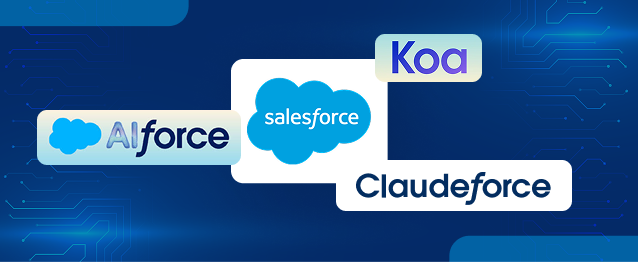
Salesforce’s September 2026 announcements have introduced several new pieces to its AI strategy, including AIforce, Koa, and the expanded Claudeforce partnership with Anthropic. They sound connected, and they are, but they are not interchangeable technologies.
For businesses already using Salesforce and Claude, the practical question is much simpler: what can teams actually use today, what can they test, and what should still be treated as an upcoming capability?
In this guide, we will look at what has actually changed, what Salesforce customers can adopt today, what is still being tested, and what businesses should verify before moving forward. The timing matters too, as Gartner expects 40% of enterprise applications to include task-specific AI agents by the end of 2026, showing how quickly agentic AI is moving into everyday enterprise software.
Salesforce Is Moving AI Beyond the CRM Screen
The biggest change is not another chatbot or another model. Salesforce is trying to make the platform accessible wherever people already work, including Claude, Slack, and other AI interfaces.
AIforce is the layer behind this approach. Salesforce describes it as a live interface layer that exposes Salesforce data, workflows, business logic, permissions, security, and governance to AI interfaces.
This is where Salesforce and Claude become particularly interesting together. Claude can provide the reasoning experience, while Salesforce remains the source of business context, permissions, workflows, and governed actions.

Generate Salesforce Documents Faster
Create quotes, contracts, invoices, proposals, and reports directly from Salesforce with powerful document automation.
The stack in simple terms
| Technology | What it actually does | Think of it as |
|---|---|---|
| AIforce | Brings Salesforce capabilities to AI interfaces | The connection and interface layer |
| Koa | Provides CRM-focused reasoning for Agentforce | The Salesforce CRM reasoning model |
| Claude | Provides Anthropic’s frontier AI reasoning | The external AI model |
| Claudeforce | Connects Salesforce and Anthropic through an expanded partnership | The partnership and integration ecosystem |
| Salesforce in Claude | Brings Salesforce capabilities directly into Claude | The customer-facing Claude experience |
So, if someone says “Koa is Salesforce’s Claude,” that is not quite right. Salesforce Koa is designed specifically for CRM reasoning, while Claude remains Anthropic’s broader AI model family.
AIforce Is About Where Salesforce Can Work
AIforce changes the traditional idea that employees must open Salesforce first and then perform their work inside its interface.
AIforce allows people and agents to access Salesforce data and workflows through interfaces such as Claude and Slack, while requests continue to use existing Salesforce permissions and business rules.
The underlying architecture uses MCP servers, APIs, plug-ins, and skills. Salesforce calls this its Headless Toolkit, giving developers ways to expose Salesforce capabilities to AI experiences without rebuilding every workflow from scratch.
This also explains why AIforce should not be described as simply another AI model. It is closer to the layer that makes Salesforce capabilities available to other AI experiences.
Koa Gives Agentforce a CRM-Focused Reasoning Model
Salesforce Koa is a different piece of the puzzle. Salesforce describes Koa as its first CRM reasoning model for Agentforce, built by post-training NVIDIA Nemotron 3 Super using a proprietary synthetic dataset modeled on nearly three decades of CRM deployments.
The purpose is not to compete with every general-purpose AI model. Koa is designed for complex, multi-step CRM work where an agent needs to reason through business processes and select the right tools.
Salesforce says its internal CRM benchmark showed Koa matching or exceeding leading model performance on CRM actions with three times fewer errors. That is a Salesforce-reported benchmark, so it should be understood as a vendor claim rather than an independent industry ranking.
Where Koa fits
- Agentforce reasoning dynamically evaluates context and intent.
- Multi-step CRM workflows are broken down into manageable execution steps.
- Opportunity and account actions execute autonomously within enterprise guardrails.
- Case routing and resolution leverage real-time context and next-best actions.
- Follow-up activities are scheduled and logged directly within Salesforce.
- Salesforce-specific business processes keep actions aligned with core governance.
- Tool selection and execution happen automatically via the Atlas Reasoning Engine.
Koa is currently available to select pilot customers, with Salesforce expecting general availability in U.S. regions in winter 2026.
Claudeforce Brings Claude Closer to Salesforce Work
Claudeforce is the expanded Salesforce and Anthropic partnership announced in August 2026. Its first major customer experience is Salesforce in Claude, which brings Salesforce context and capabilities directly into Claude.
The initial Salesforce in Claude experience includes 37 prebuilt sales skills, covering activities such as prospecting, meeting preparation, deal health, and pipeline review. Salesforce says additional capabilities for service, marketing, commerce, and industries are planned.
For developers, Salesforce also has a development plug-in for Claude Code with about 40 Salesforce development skills. Salesforce’s broader skills library contains more than 100 development skills across its products and clouds.
“AI is creating an interface revolution.” — Marc Benioff, Chair and CEO, Salesforce.
The important part here is that Salesforce and Claude are not simply sharing data through another basic connector. Salesforce says actions are routed through Salesforce so existing business rules and permissions can continue to apply.
What Can Customers Actually Use Right Now?
This is where the announcements need a little unpacking. Pilot, beta, generally available, and announced describe different levels of readiness.
A pilot normally means access is limited to selected customers for controlled testing. A beta is broader, but the capability can still change before full general availability. A generally available feature is intended for normal customer use under its published availability conditions.
The distinction matters because a feature appearing in a keynote does not automatically mean your Salesforce org can buy and deploy it tomorrow.
| Capability | September 2026 status | What it means |
|---|---|---|
| AIforce | Beta | The architecture is being introduced through initial AI experiences and interfaces |
| Salesforce Koa | Pilot | Limited customer access; GA expected winter 2026 in U.S. regions |
| Salesforce in Claude | Beta | Salesforce says it is now available to all customers in beta |
| Claudeforce | Active partnership | Individual capabilities have different availability levels |
| Claude in Agentforce | Available in supported scenarios | Claude can be used as a reasoning model for Agentforce |
| Salesforce Development plug-in for Claude Code | Available | Includes about 40 Salesforce development skills |
| Service, Marketing, Commerce and Industry skills in Claude | Coming | Salesforce says these capabilities are planned for future releases |
| Broader AIforce capabilities | Rolling expansion | Salesforce is continuing to add interfaces, skills, and integrations |
Salesforce states that availability, pricing, packaging, and regional access can vary, and customers should base purchasing decisions on products currently available to them.
What a Salesforce Customer Should Verify Before Adopting
The technology may look exciting, but adoption should start with the environment around it. The first question is not “Which model should we buy?” It is “What exactly are we allowing the model or agent to access and change?”
Check the Salesforce side
- Salesforce edition and licensing requirements
- Supported clouds and features
- User permissions and permission sets
- Data access rules
- Existing Flow and Apex actions
- API limits and integration dependencies
- Sandbox availability for testing
- Audit and monitoring requirements
Check the AI side
- Model being used for the workload
- Beta or pilot limitations
- Data retention terms
- Regional availability
- Supported Claude plan or environment
- MCP configuration
- Skill and plug-in availability
- Model behaviour for your specific workflow
Check the action layer
- Check the action layer
- Can the agent only read data?
- Can it create or update records?
- Can it send communications?
- Does a human need to approve actions?
- What happens when the model is uncertain?
- Are actions logged and traceable?
This becomes especially important as AI moves from answering questions to taking action. Gartner has warned that governance failures could lead organizations to demote or decommission autonomous AI agents, highlighting the need for controls that match the level of agent autonomy.
The Right Technology Depends on the Job
There is no single “Salesforce AI” choice here. The useful technology depends on what your team is actually trying to accomplish.
| If your requirement is… | Look at… | Why |
|---|---|---|
| Work with Salesforce context from Claude | Salesforce in Claude + AIforce | Brings CRM data, skills, and governed actions into Claude |
| Build Salesforce-native agents | Agentforce + Koa | Koa is designed for CRM-focused reasoning |
| Use Claude for Salesforce development | Claude Code + Salesforce plug-in | Provides Salesforce-specific development skills |
| Expose Salesforce outside its normal UI | AIforce + Headless Toolkit | Makes Salesforce capabilities accessible through AI interfaces |
| Keep business rules and permissions in control | Salesforce architecture + AIforce | Actions continue through Salesforce’s governed environment |
| Explore future service or marketing workflows in Claude | Claudeforce roadmap | Salesforce says additional skills are coming |
This decision map is more useful than treating every new announcement as another product to evaluate separately. The layers are connected, but they solve different parts of the AI workflow.
A Sales Example Shows the Difference
Imagine a sales representative asks Claude:
“Which opportunities need my attention today, and what should I do next?”
Claude can interpret the request and reason over the available context. Salesforce provides the underlying CRM records, permissions, workflows, and business rules.
AIforce acts as the layer connecting those Salesforce capabilities to the AI interface. Salesforce in Claude then gives the seller a way to work with that context without manually opening multiple Salesforce screens.
The result is not simply a chatbot answering a Salesforce question. The bigger idea is an AI interface that can understand CRM context and, where authorised, take governed action.
Developers Get a Different Use Case
The developer task is slightly different and honestly, this may be one of the more practical areas to test first.
Salesforce’s development plug-in for Claude Code includes about 40 skills covering core Salesforce development, while Salesforce’s broader open skills library contains more than 100 development skills.
A development team can use these capabilities for tasks such as:
- Understanding existing Apex
- Generating or modifying code
- Creating tests
- Working with metadata
- Explaining Salesforce configuration
- Running development commands
- Debugging repetitive issues
- Creating technical documentation
But AI assistance does not remove the need for architectural review. Security, governor limits, deployment strategy, data access, integrations, and business logic still need experienced Salesforce professionals to validate the final work.
“Probabilistic intelligence alone doesn’t run a company, and deterministic systems don’t reason.” — Marc Benioff, Chair & CEO, Salesforce
That distinction is probably one of the better ways to understand why Salesforce is building this architecture instead of simply putting a general AI model on top of CRM records.
The Bigger Enterprise AI Shift
The Salesforce announcements also fit into a much larger enterprise trend. McKinsey’s research found that nearly 9/10 of respondents were regularly using AI in at least one business function, but most had not yet fully scaled AI across the organization.
The challenge, therefore, is shifting from experimentation to operational value. Companies need AI to work with their existing data, processes, people, applications, and controls instead of becoming another isolated tool.
That is why the Salesforce approach is worth watching. AIforce focuses on the connection layer, Koa focuses on CRM reasoning, and Claudeforce brings Anthropic’s Claude into Salesforce workflows. Each addresses a different part of the same enterprise problem.
What Should Businesses Evaluate First?
Before moving toward a production implementation, teams can use a simple evaluation framework.
Start with the workflow
Pick one process where the current experience has a clear problem, such as:
- Pipeline review
- Account planning
- Service case analysis
- Sales follow-up
- Salesforce development
- Data lookup and summarisation
- Repetitive record updates
Define the level of autonomy
Decide whether the AI should:
Read → retrieve and explain information.
Recommend → suggest the next action.
Prepare → draft updates, messages, or records.
Act → execute an approved Salesforce action.
Starting with read and recommendation workflows can make testing easier before introducing broader write permissions.
Measure something real
Do not measure success only by how many prompts employees send. Look at outcomes such as:
- Time saved per workflow
- Record accuracy
- Task completion time
- Follow-up speed
- User adoption
- Error rates
- Human review time
- Business outcome from the workflow
This matters because broad AI adoption does not automatically equal business impact. The implementation model around the technology still matters.
What Comes Next for Salesforce Customers
Salesforce has already indicated that the initial Salesforce in Claude experience will expand beyond sales, with additional capabilities for service, marketing, commerce, industries, and Tableau planned.
Koa is also expected to move from select pilots toward general availability in U.S. regions in winter 2026. Meanwhile, AIforce is expanding the number of places where Salesforce capabilities can be accessed through AI interfaces.
The direction is fairly clear, even though every individual feature does not have the same availability. Salesforce is moving toward a model where the CRM becomes more of a trusted business intelligence and action layer, while the interface can increasingly be wherever the employee or agent already works.
“We’re together the world’s #1 AI and #1 CRM — the best of both worlds.” — Marc Benioff, Chair & CEO, Salesforce
The Takeaway for Salesforce Teams – Moving From AI Curiosity to Real Adoption
The real opportunity after Dreamforce 2026 is not simply adding another AI capability. Salesforce customers should identify where AI can remove friction, improve productivity, and support measurable outcomes before expanding adoption across teams and workflows.
For teams exploring AIforce, Salesforce Koa, or Salesforce Claudeforce, the starting point should be readiness. Data quality, governance, permissions, security, user adoption, and workflow design need to be checked first. Additionally, pilot smaller use cases before scaling them.
As Salesforce and Claude continue bringing more capabilities into enterprise workflows, adoption will keep evolving. Thus, businesses that build the right foundation now can move forward more confidently, test emerging capabilities, and decide where AI genuinely fits their day-to-day operations.
Frequently Asked Questions
Salesforce AIforce is an interface layer that lets AI experiences access Salesforce data, workflows, business logic, permissions, and governed actions.
Salesforce Koa is a CRM-focused reasoning model designed for Agentforce and complex, multi-step Salesforce workflows such as opportunity management and case routing.
Claudeforce is Salesforce’s expanded partnership with Anthropic that connects Claude with Salesforce capabilities, data, skills, and governed workflows.
It provides Salesforce-specific development skills for Claude Code, supporting tasks such as Apex development, testing, metadata work, debugging, and Salesforce configuration.
Businesses should review Salesforce licensing, permissions, data access, security, regional availability, AI model settings, governance, human approvals, and whether each capability is GA, beta, or pilot.
 India
India  USA
USA UK
UK Canada