

AI agents are moving from experiments into real business workflows, and Salesforce is changing how agent traffic to its platform will be measured. The new model matters because an agent can generate Salesforce activity even when no human is clicking through the CRM.
In 2026, Salesforce introduced Headless 360 and later evolved this direction under AIforce and the Headless Toolkit. The idea is simple. Salesforce capabilities can be accessed by agents through APIs, MCP, or CLI rather than depending on the traditional browser experience.
Now, the billing question becomes important. Salesforce has introduced Headless Platform Interaction, or HPI, for successful calls made by registered agents through MCP or direct API. The HPI multiplier is still TBA, so businesses can understand the model today but cannot yet calculate an official Salesforce MCP cost.
In this blog, we’ll explain Salesforce MCP, HPI, Headless 360, Agentic Identity, and Flex Credits in simple terms. We’ll also look at potential costs and how businesses can prepare.
Salesforce MCP Pricing Is Changing: What’s New?
Salesforce is introducing an agent-specific consumption model for calls made by registered AI agents. Once the model is active, successful calls made through MCP or the direct API will be counted as Headless Platform Interactions and tracked through Digital Wallet.
Salesforce Co-Founder Parker Harris captured the shift with a simple question:
“Why should you ever log into Salesforce again?”
The important point is that this is specifically about agentic traffic. Salesforce says traditional integrations retain their existing pricing and security model. The new approach connects agent registration, identity, governance, and billing.
A few things are especially important for businesses:
- Agent registration creates a separate identity for each agent.
- Successful agent calls through MCP or direct API become HPIs.
- Digital Wallet tracks the usage.
- Flex Credits are consumed once numerical HPI metering begins.
- The HPI multiplier is currently TBA.
The timing also matters. Gartner reported in April 2026 that only 17% of organizations had deployed AI agents, while more than 60% expected to do so within two years. That gap between current deployment and expected adoption makes usage planning increasingly relevant.
What Is a Headless Platform Interaction?
A Headless Platform Interaction, or HPI, is the Salesforce usage unit applied to every successful call that a registered agent makes to Salesforce.
There are two main routes businesses need to understand:
- MCP: An AI agent uses the Model Context Protocol to discover and invoke Salesforce capabilities.
- Direct API: A registered agent communicates with Salesforce through an API.
So, an MCP Salesforce connection is not itself the billing unit. The successful interaction made by the registered agent is what Salesforce classifies as an HPI.
This is also where Salesforce Headless becomes important. Salesforce’s Headless 360 MCP Server, currently in open beta, gives MCP-aware agents access to Salesforce operations through a single connection. Salesforce says the server can query, create, and update records, manage users, work with Apex, handle platform events, and more.
For businesses, the simple way to look at it is:
Agent action → Salesforce call → Successful interaction → HPI → Digital Wallet → Flex Credits
How Will Salesforce MCP and Agent Billing Work?
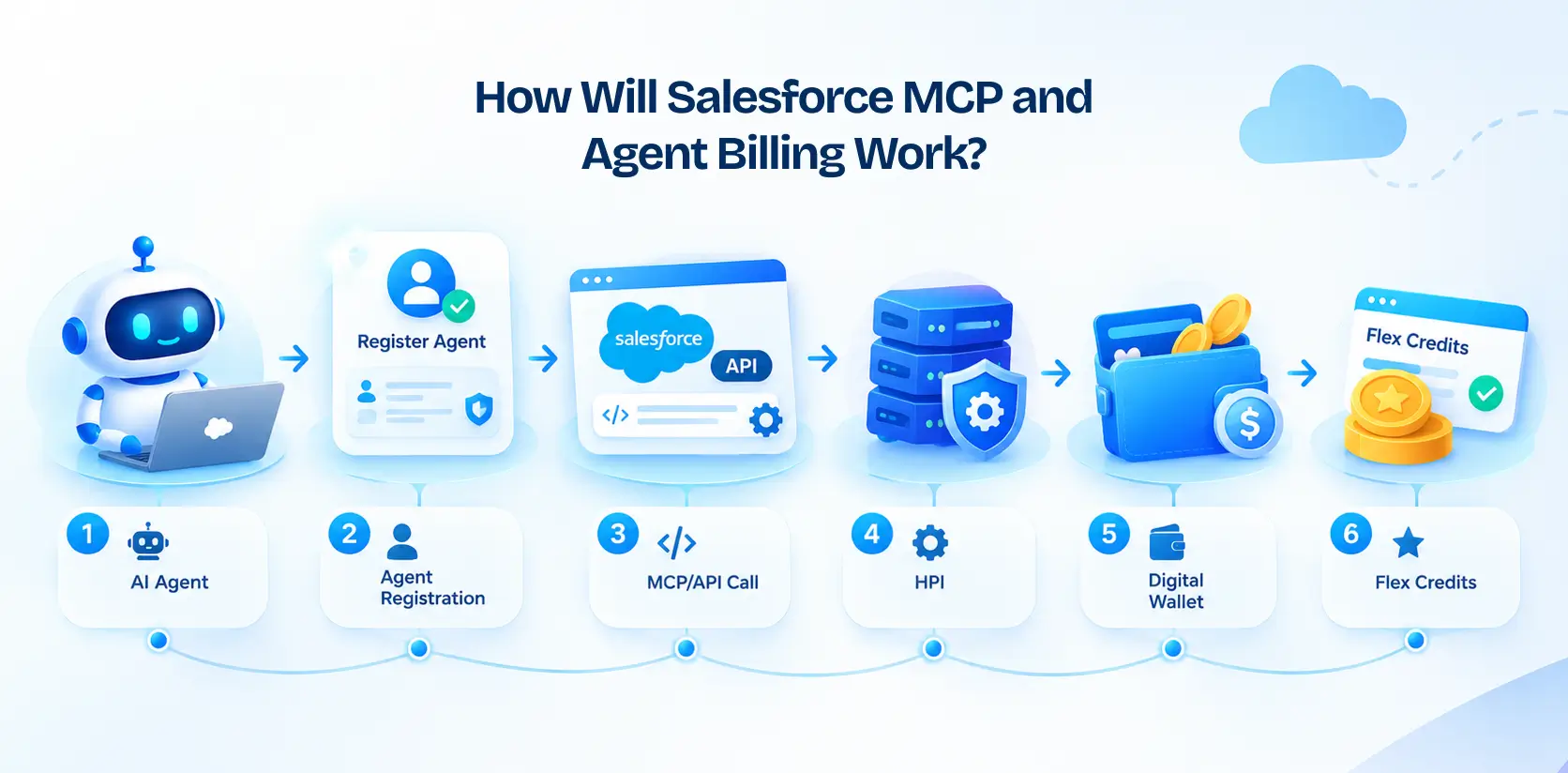
The billing flow becomes more structured once an external agent is registered:
AI Agent → Agent Registration → MCP/API Call → HPI → Digital Wallet → Flex Credits
First, Salesforce admins register the agent and give it its own Agentic Identity. This identity is separate from the human user the agent may be assisting, and administrators can assign a narrower permission set.
The agent connection then needs to be reconfigured with the OAuth credentials associated with that identity. Salesforce specifically says this applies to MCP clients as well as agents using APIs.
For an MCP Salesforce implementation, businesses should therefore consider both the technical connection and the future consumption model.
What happens after registration?
- The agent receives its own platform identity.
- Permissions can be scoped to the required actions.
- MCP clients or API agents use the new OAuth credentials.
- Successful interactions are recorded as HPIs.
- Production usage will eventually consume Flex Credits.
Salesforce’s 2026 Agentic Enterprise Index also shows why this matters. The average number of activated agents per organization increased nearly 3x over the analysis period, while the average time from agent creation to use fell by 53%.
Traditional Salesforce API integration pricing does not automatically change because of this model. Salesforce says the existing pricing and security options for traditional integrations remain as they are today.
Potential Cost of Salesforce MCP Usage
Salesforce has not announced the HPI multiplier yet. The current Salesforce MCP pricing question therefore has two parts: what Flex Credits cost today, and what the future HPI multiplier may eventually consume.
Salesforce currently lists Flex Credits at $500 per 100,000 credits. That is the current Flex Credit list price, not an HPI price. The official HPI multiplier remains TBA.
A useful planning formula is:
Estimated HPI Usage = Number of Tasks × Average Salesforce Calls per Task
For example:
| Usage Scenario | Calls per Task | Tasks per Month | Estimated HPIs |
|---|---|---|---|
| Low | 5 | 1,000 | 5,000 |
| Moderate | 10 | 5,000 | 50,000 |
| High | 20 | 10,000 | 200,000 |
Using today’s Flex Credit list price of $500 per 100,000 credits, one Flex Credit is equivalent to $0.005. If we use hypothetical HPI multipliers purely for planning, the model would look like this:
| Usage Scenario | Monthly HPIs | Assumed HPI Multiplier | Estimated Flex Credits | Illustrative Credit Cost |
|---|---|---|---|---|
| Low | 5,000 | 1 | 5,000 | $25 |
| Moderate | 50,000 | 5 | 250,000 | $1,250 |
| High | 200,000 | 20 | 4,000,000 | $20,000 |
These are not Salesforce MCP cost figures. They simply show how different multipliers would affect the same workload. Once Salesforce publishes the actual HPI multiplier, businesses can replace the assumed number and calculate their expected spend.
Important:
Salesforce has not announced the official HPI multiplier. The assumed multipliers above are illustrative planning scenarios and do not represent Salesforce’s published pricing.
This gives businesses a useful way to prepare for future Salesforce MCP pricing without treating an assumption as a confirmed rate.
How MCP Call Volume Can Affect AI Agent Costs
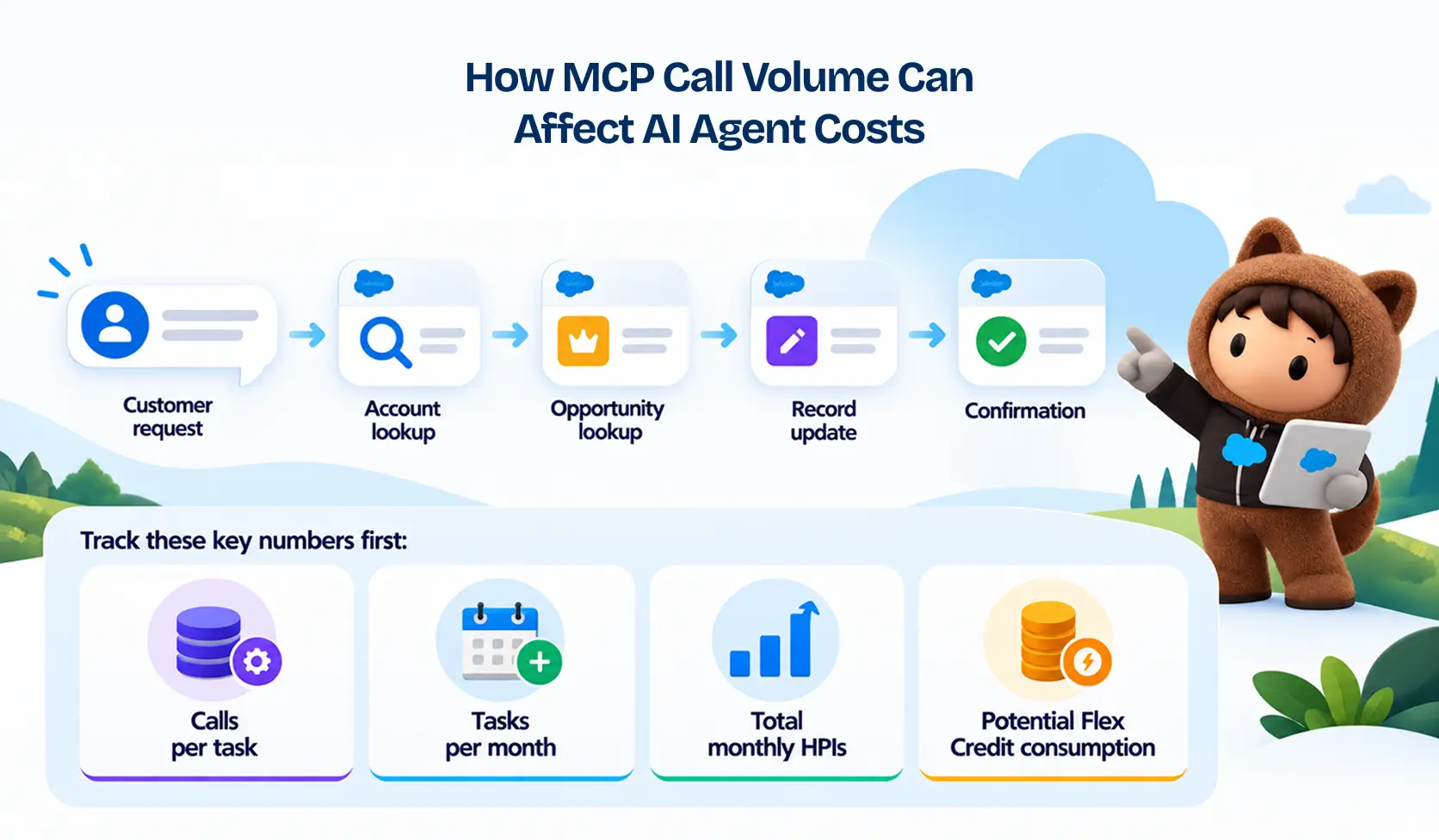
One user request does not necessarily mean one Salesforce call. An AI agent may need several calls to complete a single task.
For example:
Customer request → Account lookup → Opportunity lookup → Record update → Confirmation
If those steps create separate successful calls to Salesforce, the number of HPIs can increase even though the user submitted only one request.
This is where Salesforce MCP cost planning becomes more practical. Businesses should measure the workflow behind each task instead of looking only at the number of employees or AI agents.
Track these four numbers first:
- Calls per task
- Tasks per month
- Total monthly HPIs
- Potential Flex Credit consumption
Salesforce’s 2026 Agentic Enterprise Index found that agents are also becoming more action-oriented. The ratio of action calls to output tokens grew at a 15% compound monthly growth rate through April 2026. Salesforce also reported that the average agent’s skills increased from two to six over the analysis period.
Joe Inzerillo, Salesforce President of Enterprise AI and Technology:
“Whether you’re spinning up agents to operate at massive scale or orchestrating them through deep, multistep pipelines, the bottom line is they’re shipping real value.”
So, as agents handle more complex workflows, measuring call volume becomes more useful than simply counting prompts.
Agentic Identity: What Changes for MCP Connections?
Agentic Identity is closely connected to the new billing model. Salesforce says registration gives every external agent its own discrete platform identity rather than allowing it to operate under the identity of the person it assists.
For businesses using MCP Salesforce connections, this means the agent itself becomes part of the Salesforce security and governance model.
The main changes include:
- Register each agent.
- Give each agent its own identity.
- Assign only the permissions it needs.
- Reconfigure MCP clients with the new OAuth credentials.
- Reconfigure API-based agents where required.
- Monitor production activity after migration.
This also changes how teams should think about Salesforce API integration. The technical connection still matters, but the identity behind that connection becomes more important when the caller is an AI agent.
The wider AI market is moving in the same direction. McKinsey’s 2026 State of AI survey found that 40% of respondents from organizations with more than $1 billion in annual revenue reported scaling AI agents, compared with 27% the previous year.
That makes identity, permissions, monitoring, and cost controls increasingly relevant as businesses move agents from testing into production.
When Will HPI Metering Begin?
The current HPI multiplier is TBA, and Salesforce says agentic usage is not being metered yet. The company will provide 30 days’ notice before a numerical multiplier is added and metering begins.
Once the numerical rate is added, Salesforce says Flex Credits will be consumed for HPIs occurring in active production orgs.
The current guidance also makes the environment distinction clear:
- Production orgs will be subject to HPI metering.
- Sandboxes do not incur HPI metering.
- Scratch orgs do not incur HPI metering.
- Developer Edition orgs do not incur HPI metering.
Salesforce also mentioned customers purchasing after the September 17, 2026 publication will need to register agents using Salesforce APIs within three months of notice that Agentic Identity is available.
Existing customers using API-based agents will need to register those agents and migrate connections upon renewal. Salesforce MCP server users are also required to register agents within the stated notice period.
So, businesses should not wait for the multiplier to start understanding their current usage.
What Businesses Should Do Before Salesforce MCP Pricing Goes Live
The most practical step is to establish a baseline now. Even without an official HPI multiplier, businesses can understand how frequently their agents interact with Salesforce and where unnecessary calls may exist.
Start with these actions:
- Inventory production AI agents.
- Identify MCP and direct API connections.
- Separate agent traffic from traditional integrations.
- Measure calls required for common tasks.
- Estimate monthly HPI volume.
- Create low, moderate, and high usage scenarios.
- Review Agentic Identity and permission requirements.
- Reduce unnecessary lookups and repeated calls.
- Add usage monitoring and guardrails.
For teams planning Salesforce MCP cost scenarios, this creates a ready-made model. Once Salesforce publishes the official multiplier, the assumed value can simply be replaced with the actual rate.
Salesforce also expects agents to become more deeply embedded in enterprise workflows. Its 2026 Agentic Enterprise Index reported that retail agents handled an average of one to two actions during normal periods, while peak shopping periods could push the average retail agent to nine skills.
That difference is useful for planning because agent activity may not remain constant throughout the month. Seasonal demand, complex workflows, and multi-step tasks can all change usage patterns.
Final Thoughts
The upcoming model does not mean every Salesforce API call automatically becomes a paid HPI. Salesforce has specifically separated traditional integrations from registered agentic traffic. The new model focuses on successful calls made by registered agents through MCP or direct API.
That makes Salesforce MCP pricing an important planning topic, but it is not a finalized HPI price yet. The multiplier remains TBA, while the current Flex Credit list price is $500 per 100,000 credits.
Salesforce’s broader direction is also clear. Its Headless 360 architecture makes Salesforce capabilities available through APIs, MCP, and CLI, while the newer AIforce and Headless Toolkit approach connects those capabilities with agent identity, governance, and billing.
As Salesforce MCP cost becomes easier to calculate after the official multiplier is published, businesses will already have the most important number ready: their expected HPI volume.
For businesses already planning a Salesforce API integration around external agents, this is the right time to measure usage, review permissions, and build scenarios before the official HPI multiplier goes live.
No Data Found.

 India
India  USA
USA UK
UK Canada