Loading...

Sending documents digitally is now a core requirement for modern businesses. With eSignature for Salesforce and seamless eSignature integration, users can configure and send documents for signing directly from Salesforce, eliminating manual paperwork and speeding up approvals while keeping all data centralized and secure. In this guide, we will provide you with quick steps to send documents for eSigning using Sign Made Easy.

Step 1: To configure SME, navigate to the App Launcher, search for the Sign Made Easy app, and open it.

image26

Step 2: You will be redirected to the Sign Made Easy Setup page.

Screenshot 1

Step 3: Click the Configure SME button to initiate the connection between Salesforce and the SME Server.

Screenshot 2

Step 4: Once SME is configured successfully, click Button Creation Configuration under the Configuration section.

Screenshot 3
Screenshot 4

Step 5: Select the Salesforce object from which you want to initiate the SME process and enter the required Button Label.

Screenshot 4

Step 6: Click Create Custom Button to create the SME button.

Screenshot 6 1

Step 7: Click Go to Page Layout to navigate to the selected object’s page layout.

Screenshot 7

Step 8: Choose the required Page Layout and click on it.

Screenshot 8
Screenshot 9

Step 9: Open Mobile & Lightning Actions, then drag and drop the newly created button into the appropriate section.

Screenshot 10

Step 10: Click Save to apply the changes.

Screenshot 11 1

Step 11: Open the App Launcher, search for the object where the SME button was added, and open a record.
On the record page, click the custom button to launch the Create Transaction screen, where you can add documents and recipient details.

Screenshot 12 1
Screenshot 13 1

Step 12: Click Upload Documents and add the files you want to send for eSigning.

Screenshot 14
Screenshot 15

Step 13: Click Add Recipients and enter the required recipient information.

Screenshot 16
Screenshot 17

Step 14: The required tags have already been added to the document through the sign parameter; you can proceed directly by clicking the ‘Begin In Person Signing‘ button. Otherwise, click the ‘Preview and Tag‘ button to add the necessary tags to the document before proceeding.

Screenshot 18
Screenshot 19

Step 15: Click Continue to proceed.

Screenshot 20

Step 16: Verify the recipient name, email address, and document authorization, then click Continue.

Screenshot 21 1

Step 17: Click I Agree to accept the consent.

Screenshot 22 1

Step 18: Click the Signature tag to place the signature.

Screenshot 23
Screenshot 24 1

Step 19: Next, click Adopt Signature and Sign to apply the selected signature style.

Screenshot 35 1

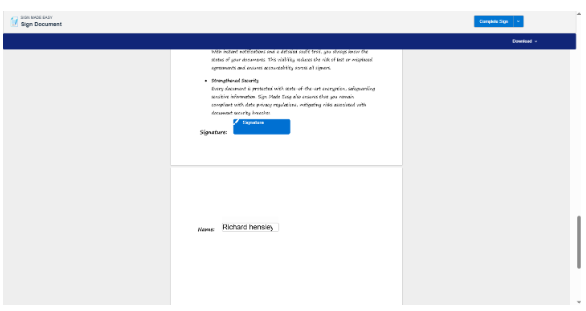
Step 20: Click Complete Sign to finish the signing process.

Screenshot 36

Step 21: Click Continue to confirm that the first recipient’s signing is complete.

Screenshot 37
Screenshot 38

Step 22: Click Complete In Person Signing to finalize the in-person signing flow.

Screenshot 29 3

Step 23: The second recipient receives an email notification and clicks View Document.

Screenshot 30 1
Screenshot 31 1

Step 24: The recipient clicks I Agree to proceed.

Screenshot 32 2 1
Screenshot 33 1

Step 25: Click the Signature tag to apply the signature.

Screenshot 34 2

Step 26: Click Adopt Signature and Sign to complete the signing.

Screenshot 35 2

Step 27: Click Complete Sign to finalize the document.

Screenshot 36 1

Once completed, the signing process is finished, and a confirmation email is sent to all recipients.

Screenshot 37 1
Screenshot 38 1
Screenshot 39

Watch the Demo

Conclusion

This step-by-step flow streamlines how Sign Made Easy capabilities simplify document signing while keeping everything within Salesforce. Using Salesforce eSignature, teams can ensure faster approvals, better compliance, and a fully digital signing experience without leaving the CRM.

By implementing the Salesforce eSignature solution, your business can build reliable, end-to-end digital document workflows. HIC Global Solutions offers Salesforce services that simplify and optimize your signature workflows. By ensuring eSignature processes align seamlessly with your business operations, HIC Global Solutions enables faster execution, stronger compliance, and consistent results across teams.

No Data Found.

Share This Blog
Table of contents
Related Articles
Dark Mode in Salesforce Enabling It and Creating Theme Ready Lightning Web Components with SLDS 2.0 1 1

With the Winter ’26 release, Salesforce introduced Dark Mode in Lightning Experience. Dark Mode has been introduced as a beta feature in Winter ’26, and at first it was available only for Starter Edition orgs. It is now rolling out further with Spring ’26 to Professional, Enterprise, and Developer editions. To use Dark Mode, Salesforce […]

Read More
How to Merge and Brand PDF Files in Salesforce Using LWC Visualforce PDF LIB 1

Salesforce developers frequently encounter document automation requirements that go beyond standard Apex-based PDF generation. From merging multiple ContentVersion files to dynamically applying branding like watermarks and headers, traditional server-side approaches often hit Salesforce heap size limits (6MB/12MB), creating performance and scalability challenges. This guide presents a heap-limit-safe PDF merging architecture in Salesforce using Lightning Web […]

Read More
Building a Reusable Popup Modal Architecture in Salesforce LWC 02 1

Modern Salesforce applications frequently rely on popup modals for confirmations, warnings, access control decisions, and destructive actions. However, building modal logic separately inside every Lightning Web Component often leads to duplicated code, inconsistent user experiences, and growing technical debt. This blog introduces a flexible popup modal architecture in Lightning Web Components (LWC) that centralizes modal […]

Read More
How to Add a Lookup Recipient in a Sign Template

This step-by-step guide will provide you with quick steps on how to add a lookup recipient inside a sign template in just a few easy steps. This process improves your eSignature for Salesforce workflow by pulling recipients directly from related records. Whether you rely on Salesforce digital signature features or any eSignature integration, adding lookup […]

Read More
Agentforce VS code

As Salesforce continues to move toward AI-assisted development, Agentforce is emerging as a powerful tool that helps developers interact with their org metadata, objects, and configurations using intelligent prompts. When combined with Visual Studio Code (VS Code) and the Salesforce CLI, Agentforce enables a faster, more context-aware way to explore and build on the Salesforce […]

Read More
How to Allow Standard Salesforce Users to Add or Remove Queue Members Securely

Managing Salesforce queues is typically restricted to system administrators, which often creates operational slowdowns for teams that need faster control over their assignments. When non-admin users must rely on admins for routine queue updates, productivity drops, and simple changes turn into avoidable delays. In this blog, we’ll walk through a practical workaround to this limitation […]

Read More
Our Location worldwide
Indian Flag India
3rd Floor, A-10, Pegasus Tower, Sector 68, Noida, Uttar Pradesh 201301 +91-1203239658
United States of America Flag USA
333 West Brown Deer Road Unit G – 366 Milwaukee WI, USA 53217 +1(262) 310-7818
United Kingdom Flag UK
7 Bell Yard, London, WC2A 2JR +44 20 3239 9428
Canada Canada
HIC Global Solutions INC
6D - 7398 Yonge St #1124 Thornhill, ON L4J 8J2 Canada +1(262) 310-7818