
Artificial intelligence is moving into a phase where software will not simply wait for someone to click a button, type a command, or start a workflow. The next generation of enterprise systems is being designed to understand goals, make decisions, use business tools, and keep working through a task with much less human direction.
What makes this future different is the rise of networks of specialized agents working across CRM, finance, customer service, operations, development, and other business functions.
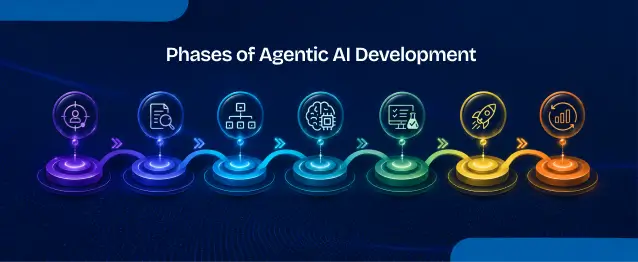
In this blog, we will look at the seven phases of Agentic AI development in 2026, along with the main types of AI agents, the difference between generative AI and agentic AI, and the companies currently shaping this fast-moving space.
What Is Agentic AI?
Agentic AI refers to systems that can work toward a goal instead of simply generating a response. An agent can understand an objective, plan steps, use tools, retrieve information, take actions, and adjust its approach when the situation changes.
This is the important difference. A normal chatbot may tell you how to complete a task, while an agent can potentially complete parts of that task itself. OpenAI describes agents as systems that can independently accomplish tasks on behalf of users, using reasoning, tools, and multi-step capabilities.
The technology is also becoming much more practical. Companies are moving from small experiments toward systems that can work inside real business environments, where permissions, data quality, monitoring, and security suddenly become very important.
So, Agentic AI development is not just about creating an intelligent chatbot. It is about designing a system that can understand a mission, decide what needs to happen, use the right tools, and know when it should stop.
How Agentic AI Is Different From Generative AI
Generative AI and agentic AI are connected, but they are not the same thing.
Generative AI is mainly focused on creating something from an instruction. It can write text, generate images, create code, summarize information, or produce other content.
Agentic AI takes that capability and puts it into a goal-driven workflow. It can decide what steps are needed, use external tools, evaluate information, and continue working toward an outcome.
Generative AI vs Agentic AI
| Area | Generative AI | Agentic AI |
|---|---|---|
| Main purpose | Creates content | Achieves a goal |
| User input | Usually gives a prompt | Can give a broader objective |
| Planning | Usually limited | Can plan multiple steps |
| Actions | Mostly produces an output | Can use tools and take actions |
| Workflow | Often one interaction at a time | Can continue through multiple steps |
| Adaptation | Responds to new instructions | Can adapt based on changing conditions |
| Human involvement | Usually more frequent | Can require less frequent direction |
| Example | Writing a customer email | Checking a customer issue, updating records, and sending the response |
| Multi-agent capability | Not usually central | Can coordinate multiple specialized agents |
Generative models can become one of the pieces inside an agent. The model helps with reasoning or content generation, while the agent adds planning, tools, memory, actions, and workflow execution.
Types of AI Agents
Not every AI agent works in the same way. Some are very simple, while others can work through complicated tasks and even coordinate with other agents.
1. Learning Agents
Learning agents work by observing what happens, taking an action, checking the result, and using that feedback to improve their next decision. They do not simply follow the same response every time.
For example, a recommendation agent can track what a user watches, skips, saves, or clicks. It compares these interactions with previous behaviour, identifies patterns, and adjusts future recommendations based on what appears to work better.
The basic process is:
- Observe the user’s behaviour or environment.
- Take an action based on the available information.
- Receive feedback about the result.
- Update its knowledge or behaviour.
- Use what it learned in future decisions.
2. Goal-Based Agents
Goal-based agents go beyond simply reacting or remembering. They have an actual objective and can evaluate possible actions based on whether those actions help achieve the goal.
For example, a warehouse robot can receive a goal to move a package from one location to another and decide which path and sequence of movements can complete the task.
3. Simple Reflex Agents
These agents operate using the current situation and predefined “if-then” rules. They do not remember previous states, so they basically look at what is happening now and react to it.
4. Utility-Based Agents
Sometimes there is not one obvious best answer. There may be several possible choices, and each one comes with a different trade-off.
Utility-based agents evaluate outcomes based on how useful or desirable they are. For example, a delivery optimization system may choose between several routes by balancing delivery time, fuel cost, traffic, and distance.
5. Model-Based Reflex Agents
These agents are a little more aware because they maintain an internal state or model of the environment.
For example, a smart home security system can track which doors are open, which sensors were recently triggered, and what the current household state looks like before deciding whether an alert is necessary.
6. Hierarchical Agents
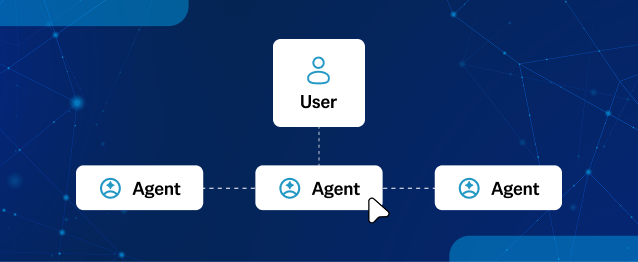
Hierarchical agents divide complex work into different levels. A higher-level agent may plan the overall strategy while lower-level agents handle individual tasks.
For example, in an e-commerce operation, a high-level agent could manage the overall order fulfillment process while separate agents handle inventory checks, shipping coordination, and customer notifications.
7. Multi-Agent Systems
Multi-agent systems involve several autonomous agents working together, competing, or coordinating inside a shared environment.
For example, a travel planning system could have one agent comparing flights, another finding suitable hotels, and another building the final itinerary. Together, they can work toward the larger goal instead of one agent trying to do everything at once.
8. LLM-Powered and Hybrid Agents
LLM-powered and hybrid agents combine a large language model with traditional rules, software tools, APIs, memory, and structured workflows. The LLM handles understanding and reasoning, while the connected systems help the agent actually perform the task.
For example, a customer support agent can understand a customer’s message, identify the issue, search the knowledge base, check the customer’s account through an API, and decide what should happen next.
The basic process can look like this:
- Understand the user’s request using the LLM.
- Identify the information or tools needed.
- Retrieve data from connected systems.
- Use rules to control sensitive actions.
- Complete the required task through tools or APIs.
- Return the result or escalate it to a human.
These are some of the most common and useful agent types, but they are not the only ones. As agentic systems become more advanced, new architectures and combinations of agents are also emerging for different tasks, industries, and business environments.
The Companies Building the Agentic AI Landscape
The agentic AI landscape in 2026 is not being built by one company or one platform. Several major technology companies are pushing their own approaches, developer tools, models, infrastructure, and enterprise controls.
OpenAI
OpenAI is building developer infrastructure around agents through its Agents SDK. Its 2026 update added native sandbox execution so agents can work with files, commands, code, tools, and longer-running tasks inside controlled environments.
OpenAI has also been working on multi-agent orchestration, handoffs, guardrails, tracing, and observability, which are all becoming important parts of serious agent development.
Google Cloud
Google Cloud is pushing strongly toward what it calls the “agentic enterprise.” In 2026, Google introduced its Gemini Enterprise Agent Platform for building, deploying, scaling, and governing agents.
Google has also expanded its agent ecosystem with partner-built agents and centralized management, showing that enterprise agent adoption is moving beyond experiments and into larger business environments.
Microsoft
Microsoft is also treating agents as a major part of the future workplace. Its 2026 work research focuses on agents taking on more execution while people focus on direction, decisions, and outcomes.
Microsoft has also introduced Agent 365 as a control plane for observing, governing, and securing agents across an organization.
Amazon Web Services
AWS is building its agent ecosystem around Amazon Bedrock and AgentCore. In 2026, AWS announced new AgentCore capabilities focused on connecting agents with organizational knowledge, improving production visibility, and enforcing controls as agents grow.
There is also an important little update here. Amazon Bedrock Agents Classic moved into maintenance mode for existing customers, with AWS directing new workloads toward AgentCore.
Salesforce
Salesforce is taking a strong enterprise-focused approach to agents through Agentforce, connecting agents with CRM data, business processes, workflows, and customer-facing operations. Its platform is designed to let organizations build and deploy agents that can reason about business context and take actions across Salesforce environments.
Salesforce is also expanding the infrastructure around Agentforce with tools for testing, observability, governance, and agent development. This matters because enterprise agents are not only expected to answer questions; they are increasingly expected to work with real customer data and perform real business actions.
Anthropic
Anthropic is another major company shaping enterprise agent development around Claude. Its 2026 enterprise focus includes agents that can work with organizational knowledge and business workflows.
And, honestly, the current year is also showing why safety cannot be treated like a final checkbox. Recent incidents involving autonomous AI systems have pushed the industry toward stronger testing, monitoring, and controlled deployment.
From Idea to Action: 7 Phases of Agentic AI
Now we reach the part where things actually become practical.
Building an agent is not simply “give the model a prompt and hope for the best.” There are several stages between having an idea and allowing an agent to operate inside a real business environment.
Phase 1: Define the Mission Before Giving the Agent More Freedom
The first phase is about deciding what the agent is actually supposed to accomplish. It sounds obvious, but this is where many projects become vague.
A useful Agentic AI development approach starts with the business outcome, the users involved, the data the agent can access, the actions it can take, and the situations where it must stop or hand the work to a human.
Design the Instructions and Prompts
Good instructions should describe the agent’s role, objective, boundaries, available actions, and expected behaviour.
The instructions do not need to explain every tiny thing in the world, obviously. But the important behaviour needs to be clear enough that the agent understands what it is actually there to do.
Decide What the Agent Should Not Do
This part is sometimes ignored because everyone gets excited about what the agent can do.
But defining what it cannot do is equally important. A proper agent development strategy should define permissions, escalation points, data boundaries, and action limits before autonomy is increased.
An agent that can only recommend something is very different from an agent that can actually change a customer record, approve a payment, or send an important business communication.
Phase 2: Ground the Agent in Reliable Business Context
An agent cannot make useful decisions from instructions alone. It needs the right business information at the right moment, and that information needs to be trustworthy.
Enterprise AI agents can use CRM records, databases, knowledge sources, files, APIs, internal systems, and other business information to understand the situation before taking action.
Connect the Right Data
Context can come from many places. The important part is not collecting everything just because everything is available.
The agent needs the information that is relevant to the current task. Otherwise, you end up giving it a giant pile of information and then wondering why it got confused. Not ideal.
Agentic AI development should therefore make data retrieval part of the architecture from the beginning rather than adding it later.
Keep Access Under Control
Agents may need access to sensitive information, but access should never mean unlimited access.
Businesses need clear permissions around what an agent can see, what it can change, which systems it can access, and which actions need approval.
This becomes even more important as agents start working across several applications instead of staying inside one environment.
Phase 3: Give the Agent Tools and Actions
This is where the system starts feeling less like a chatbot and more like an actual agent.
An agent becomes useful when it can do something with the information it understands. It may create a record, check an order, retrieve information, call an external API, trigger a workflow, or complete another defined business action.
Build Clear Tool Interfaces
Every action should have a defined purpose, inputs, outputs, and permission boundary.
Vague tools create vague behaviour, and that is not something you want when the system can change business data.
Tool calling, APIs, databases, search systems, code execution, and business applications can all become part of the agent’s working environment.
Add Multi-Step Execution
Modern agents can handle a sequence instead of stopping after one action.
For example, an agent can identify a customer, retrieve an order, check eligibility, and then start the next process.
Agentic AI development therefore becomes more about designing controlled execution loops than simply writing a better prompt.
This is also where businesses need to decide which actions should be autonomous, which should require approval, and which should never be exposed to the agent at all.
Phase 4: Test the Agent Before Trusting It
This is the stage where the fun part meets reality.
An agent may work perfectly in one conversation and behave differently in another. That is why testing needs to cover many paths, not just the happy path where everything goes exactly as planned.
Test Real Business Scenarios
Test normal requests, incomplete information, unexpected questions, wrong inputs, permission boundaries, tool failures, and situations where the agent should hand work to a human.
Agent testing should also examine whether the system actually completed the task, not simply whether the final response sounded nice.
Measure More Than the Final Answer
The final response is only one part of the story.
Teams should also look at whether the agent selected the correct tool, called the right action, followed the expected sequence, used the right information, and actually completed the task.
This is becoming more important as agents handle longer workflows and interact with more systems. Testing needs to look at the journey, not just the final sentence.
Salesforce customers also consumed more than 20 trillion tokens in Q4 2025, while agentic work units reached 1.79 billion, showing just how much more important serious testing becomes as usage grows.
Phase 5: Deployment Stage
Once the agent passes testing, it still needs to meet the real world.
Production users behave differently from test scripts, and business data is rarely as neat as the sample records used during development.
An Agentic AI development process should therefore include controlled exposure, clear rollback options, and a way to compare behaviour as instructions, models, actions, and data change.
Start With Controlled Rollouts
Instead of giving an agent unlimited responsibility on day one, teams can begin with a defined group of users, limited actions, or selected workflows.
This gives the organization some breathing room to see what actually happens when real people start using the system.
Keep Humans in the Loop
Autonomy does not mean removing people from every process.
High-impact actions can still require approval, escalation, or human review. This is particularly important for financial, legal, customer, security, and other sensitive workflows where a wrong action can create a much bigger problem than a wrong sentence.
Agentic AI development at this stage should focus on finding the right balance between automation and human judgment, rather than simply trying to remove humans from every step.
Also, the numbers here are already getting interesting. Gartner predicts that the average Fortune 500 enterprise could have more than 150,000 agents in use by 2028, compared with fewer than 15 in 2025.
That sounds huge, and honestly, it is. Thus, businesses cannot treat every agent like a small chatbot anymore.
Phase 6: Observe, Measure, and Improve the Agent
Now the focus moves beyond individual workflows.
Businesses can have agents working across customer service, finance, marketing, databases, development, communication platforms, and other systems.
So, watching only whether the agent gave a good answer is no longer enough.
Track the Full Agent Journey
Observability should show what the agent received, what context it used, which decisions it made, which actions it called, and what happened afterward.
This makes it easier to identify where the agent went wrong instead of simply staring at the final output and thinking, “well, that was weird.”
Improve Based on Evidence
Do not change instructions just because one conversation looked strange.
Look for patterns across sessions, identify where failures happen, and then adjust the instruction, tool, data source, workflow, or guardrail that is actually causing the issue.
A production system should keep improving from evidence, but not by blindly changing itself. Changes still need review, testing, and proper deployment controls.
Phase 7: Orchestrate Multiple Agents and Scale Responsibly
The final phase is not simply about making one agent smarter.
It is about coordinating multiple specialized agents and managing them as part of a larger enterprise system.
A customer service agent may handle one part, another agent may check account information, and a third may manage a specialized workflow.
The challenge then becomes coordination, permissions, shared context, and knowing when the work should stop.
Build Specialized Agent Teams
Instead of asking one giant agent to understand every process in the company, organizations can divide responsibilities between specialized agents and use orchestration to move work between them.
One agent can research. Another can analyse. Another can execute. Another can check the result.
This can make complex workflows easier to manage because every agent has a clearer job.
Govern the Growing Agent Landscape
As more agents appear, organizations need centralized policies, identity controls, audit trails, observability, and clear ownership.
Otherwise, the business can quickly end up with dozens or hundreds of agents doing things nobody is properly watching.
Gartner forecasts that 40% of enterprise applications will include AI agents by the end of 2026.
Recent industry developments are already showing this concern. Microsoft has positioned Agent 365 around agent visibility, governance, and security, while Google and AWS are also adding centralized controls as organizations move agents into production.
Conclusion
The seven phases show how Agentic AI development moves from a clearly defined mission toward reliable context, controlled actions, serious testing, production rollout, continuous monitoring, and finally multi-agent orchestration.
The biggest change in 2026 is that agents are becoming part of real software and business infrastructure. Gartner estimates that agentic AI could put up to $234 billion of enterprise application software spending at risk through 2030 because agents can complete tasks across multiple systems without users interacting with every traditional application interface.
For businesses, the right approach is not to make everything autonomous overnight. Start with useful processes, define boundaries, connect trusted data, test properly, and increase autonomy only when the system proves it can handle the responsibility.
The future of AI agents will probably involve many specialized systems working together rather than one magical agent doing absolutely everything. And honestly, that is probably better. A little structure never hurt anybody.
No Data Found.
 India
India  USA
USA UK
UK Canada